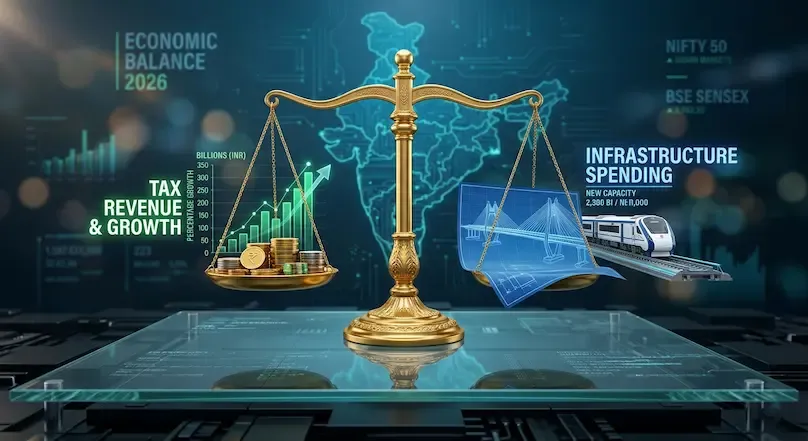
Infographic showing India’s fiscal deficit trajectory toward 2026, comparing capital expenditure outlays with tax revenue growth – Akhand News Financial Report.
1. Introduction: The Balancing Act
In 2026, the Indian economy stands at a critical juncture. The Union Budget for the fiscal year has set an ambitious target to bring the fiscal deficit down toward the 4.5% of GDP mark by the end of this cycle. Following the heavy capital expenditure (Capex) cycles of previous years, the question remains: Can the government sustain high growth while keeping its debt-to-GDP ratio in check?
2. The Current Numbers: Targets vs. Reality
The government’s fiscal deficit—the gap between total expenditure and total revenue—is being monitored closely by global rating agencies.
- Targeted Reduction: The roadmap suggests a glide path from 5.1% in the previous year toward a more sustainable 4.5%.
- Revenue Surplus: Buoyant GST collections and a significant surge in direct tax compliance in early 2026 have provided the treasury with much-needed "breathing room."
- Expenditure Growth: While subsidies on fertilizers and food remain high, there is a visible shift toward "Quality of Expenditure," prioritizing infrastructure over populist doles.
3. Major Drivers of Government Spending in 2026
- Infrastructure Push (Capex): The government continues to lead the investment cycle, with massive outlays for the Gati Shakti projects and the expansion of the high-speed rail network.
- Digital Public Infrastructure (DPI): Significant funds are being allocated to modernize India’s digital stack, including AI-driven governance and cybersecurity.
- Climate Transition: Subsidies for Green Hydrogen and the PLI (Production Linked Incentive) schemes for renewable energy are major components of the 2026 budget.
4. Tax Revenue: The Pillar of Stability
The strength of the 2026 fiscal position is largely due to the "Tax-to-GDP" ratio reaching a historic high.
- GST Regularization: The monthly GST collection floor has now stabilized at approximately ₹1.85 Lakh Crore, thanks to AI-led tracking of tax evasion.
- Direct Tax Surge: A growing middle class and digitized filing systems have increased the number of active taxpayers significantly by May 2026.
5. The Debt-to-GDP Challenge
Despite the deficit narrowing, India’s total public debt remains a point of discussion.
- Interest Burden: A large portion of the revenue still goes toward servicing old debt.
- Global Inclusion: The inclusion of Indian government bonds in global indices has lowered borrowing costs, but it also exposes the local economy to global market volatility.
6. The Role of States in Fiscal Discipline: The Federal Balance
In 2026, India’s fiscal health is not just a "Central" story; it is a collaborative effort with the states. Under the recommendations of the 16th Finance Commission, the relationship between the Union and State finances has reached a new level of maturity.
- Performance-Linked Borrowing: The Centre has successfully implemented a "Carrot and Stick" model. States like Maharashtra, Gujarat, and Tamil Nadu—which contribute significantly to the national GDP—are being incentivized with additional borrowing room if they meet specific targets in power sector reforms and ease of doing business.
- The 3% GSDP Limit: While the Centre targets 4.5%, the states are mandated to keep their fiscal deficits within 3% of their Gross State Domestic Product (GSDP). In 2026, most states are in compliance, though debt-stressed states are under strict "Fiscal Correction Paths" monitored by the RBI.
- Capital Outlay at State Level: For the first time, states are mirroring the Centre’s Capex (Capital Expenditure) model. Investment in state highways, irrigation, and urban rejuvenation projects in 2026 is at an all-time high, ensuring that the "Growth Engine" isn't just running on one cylinder.
7. Social Sector Spending vs. Capital Investment: The "Quality of Debt" Debate
A critical discussion in 2026 revolves around the "Quality of Expenditure." Economists argue that not all debt is bad; debt used to build assets (Capex) creates future revenue, whereas debt used for consumption (Revenue Expenditure) can be dangerous.
- The Infrastructure Overhaul: In 2026, nearly 25% of the total budget is dedicated to Capital Expenditure. This "Asset Creation" strategy ensures that every Rupee spent today generates nearly ₹2.5 to ₹3 in long-term economic activity.
- Ayushman Bharat 2.0 & Social Safety: While infrastructure is the priority, the social safety net has expanded. The 2026 budget sees a record allocation for Ayushman Bharat 2.0, which now covers the "Missing Middle" (middle-class families) for catastrophic health expenses. This spending is viewed as "Human Capital Investment," essential for a productive workforce.
- Education & Skill India: With the "Digital Divide" narrowing, 2026 spending is heavily focused on AI-literacy and vocational training. The government is moving away from just "Funding Schools" to "Funding Outcomes," ensuring that fiscal outlays translate into a job-ready population.
8. Global Headwinds: The Oil, Interest, and Geopolitical Nexus
India’s fiscal deficit in 2026 remains highly sensitive to external shocks. No matter how disciplined the internal planning is, global factors can derail the budget.
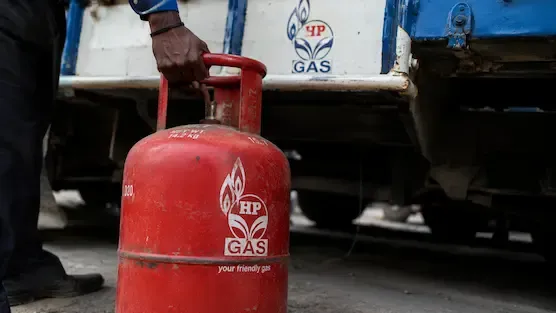
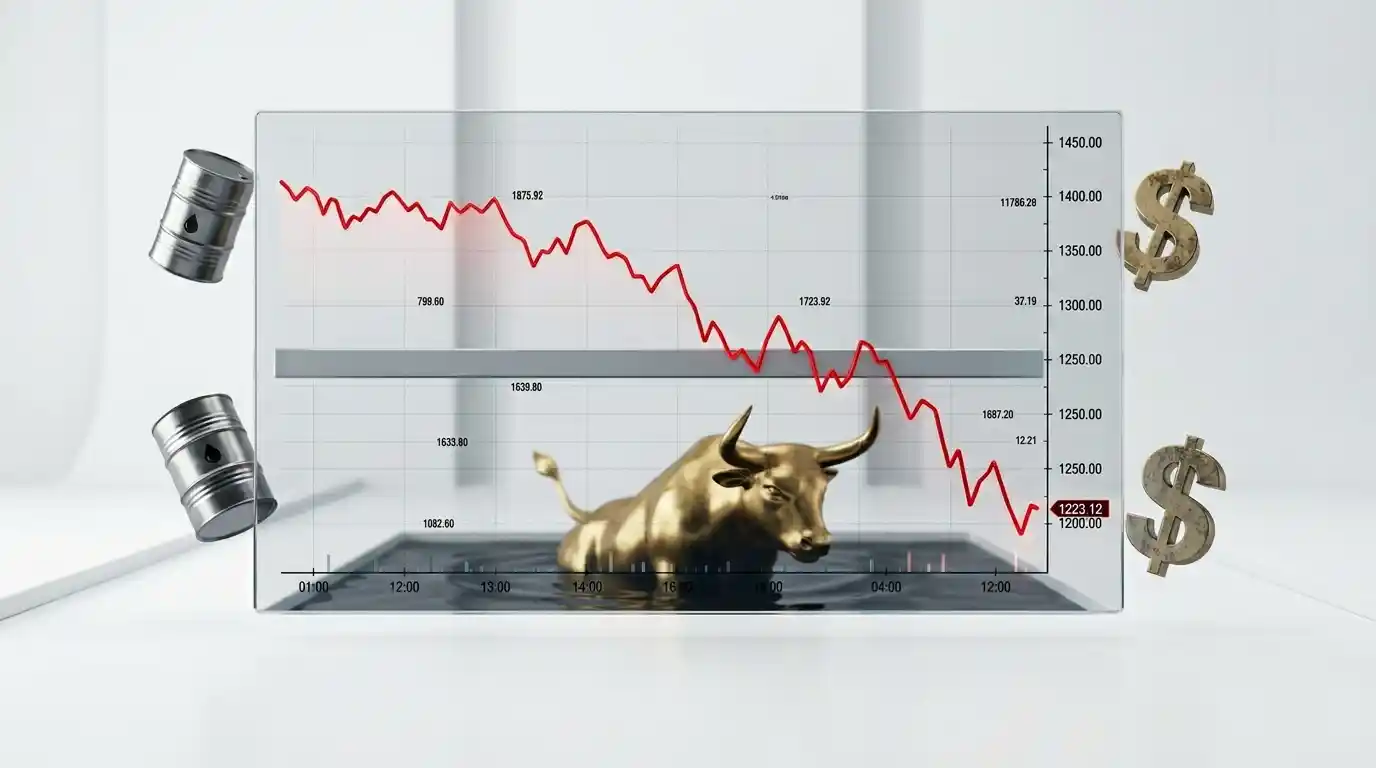
- The "Crude" Reality: As of May 2026, India still imports over 80% of its oil. A $10 per barrel spike in global crude prices adds approximately ₹1.2 Lakh Crore to India's trade deficit and puts immense pressure on the fertilizer and LPG subsidy bills. The 2026 strategy involves "Strategic Petroleum Reserves" and a rapid shift to Ethanol blending to insulate the budget.
- Global Interest Rate Cycles: With Indian Government Bonds (IGBs) now part of major global indices, the Indian Rupee is more integrated with the US Federal Reserve's decisions. In 2026, higher global interest rates make "Debt Servicing" more expensive for India, forcing the Finance Ministry to balance domestic growth with global attractiveness.
- Supply Chain Resiliency: Geopolitical tensions in 2026 have led to "Friend-shoring." India’s spending on defense manufacturing and semiconductor PLI schemes is a direct response to this, ensuring that the fiscal deficit is used to build "Strategic Autonomy."
9. The Path to "Viksit Bharat" 2047: 2026 as the Foundation
The 2026 fiscal discipline is not an end in itself; it is a foundational step toward the 2047 Vision of a $30 Trillion economy.
- Fiscal Consolidation as a Brand: By staying committed to the glide path, India is marketing itself as a "Stable and Predictable" economy. This attracts Foreign Direct Investment (FDI) that seeks long-term safety, further reducing the need for the government to borrow.
- Digital Governance & Leakage Prevention: The "Digital Stack" in 2026 has virtually eliminated "Ghost Beneficiaries." Through AI-audits and Direct Benefit Transfer (DBT), the government is saving an estimated ₹3.5 Lakh Crore annually, which is directly diverted into lowering the deficit.
- Urban-Rural Equilibrium: The 2026 budget emphasizes "Rurban" development—bringing urban amenities to rural clusters. This prevents the massive, unplanned migration to cities like Mumbai or Delhi, which creates fiscal "Stress Points" in urban infrastructure.
- The Zero-Deficit Dream: While 0% deficit is unrealistic for a developing nation, the 2026 roadmap envisions a future where the Primary Deficit (deficit excluding interest payments) becomes zero, signifying that the country is finally earning enough to cover all its current expenses.
In conclusion, India’s fiscal story in 2026 is one of calculated ambition. The government is successfully walking the tightrope between "Spending for Growth" and "Saving for Stability." By prioritizing capital assets over populist subsidies and leveraging technology to maximize tax revenue, India has managed to keep its spending under control despite global volatility.
As we move toward the latter half of the decade, the discipline shown in 2026 will be remembered as the moment India moved from "Managing Crisis" to "Leading Growth." The world is no longer asking if India can afford its dreams; the world is asking how fast India can achieve them.
Read Also: Inflation 2026: Is the Cost of Living Falling or Set to Rise Further?