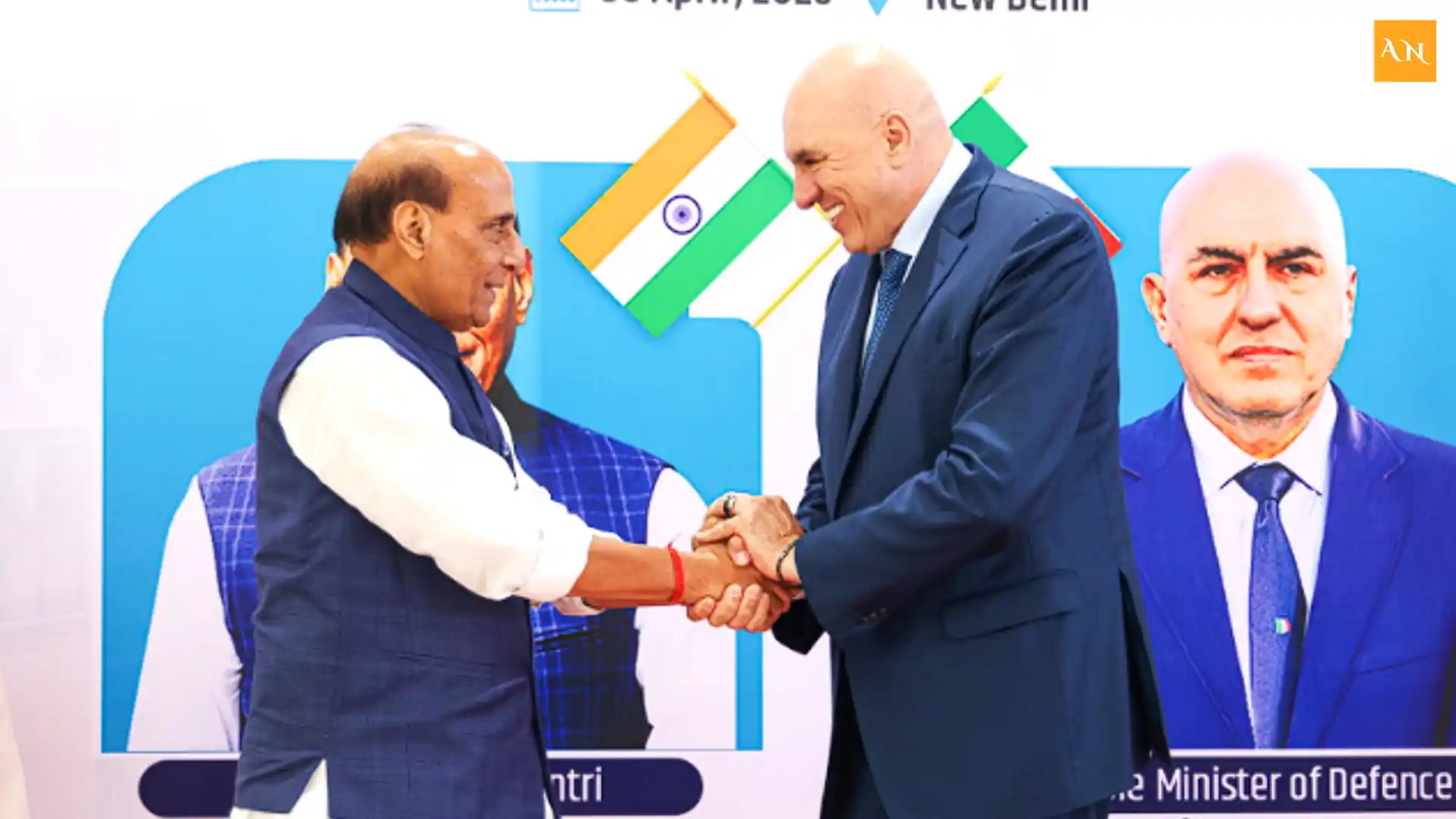
Leaders of India and the US shaking hands at a 2026 Strategic Dialogue in Washington D.C.
1. Introduction: Beyond a Transactional Relationship
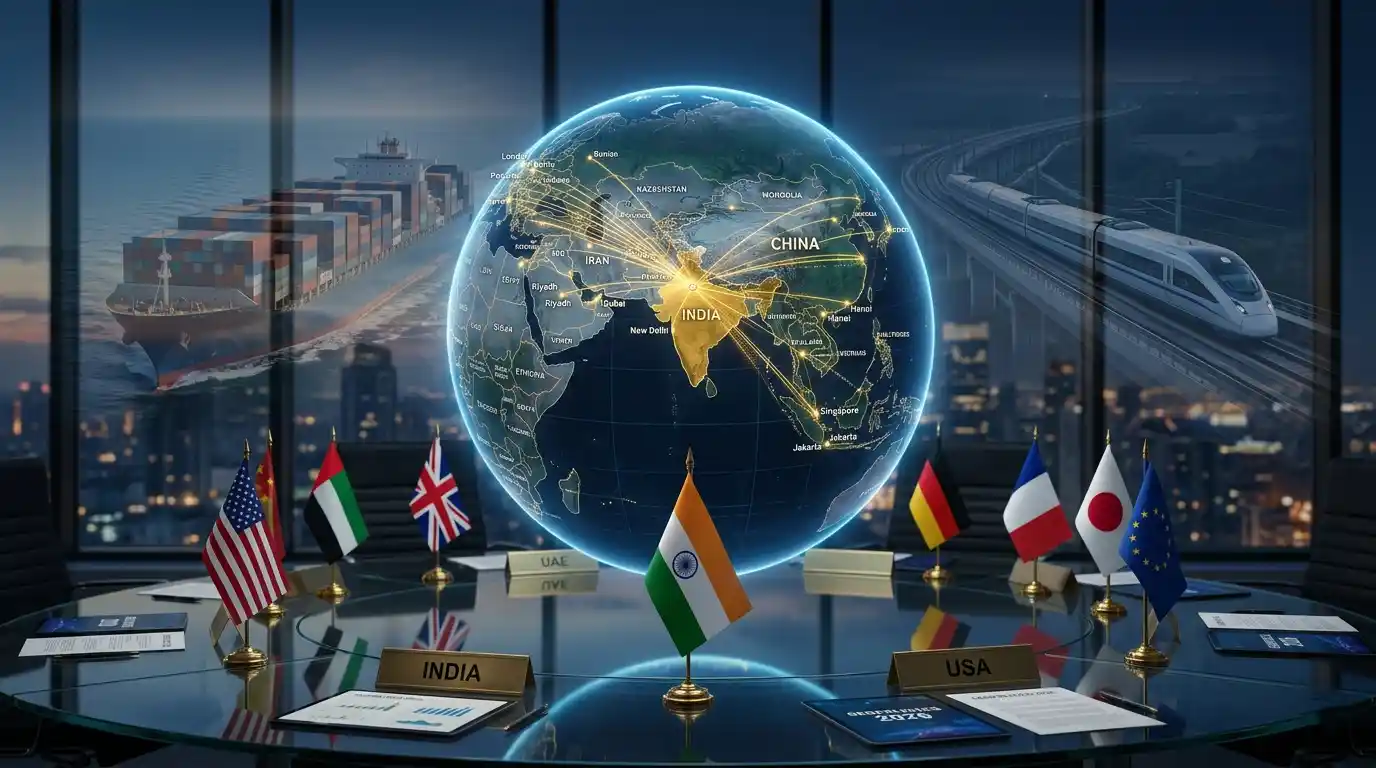
By May 2026, the India-US relationship has matured into a "Partnership of Necessity and Ambition." No longer defined merely by shared democratic values, the alliance is now cemented by a hard-coded strategic alignment in the Indo-Pacific and a deep-seated integration of their technology ecosystems. As India grows as a global manufacturing hub and the US seeks "friend-shoring" partners, 2026 marks the year this duo becomes the primary engine of global democratic stability.
2. Defence: From Buyer-Seller to Co-Producer
The defense pillar of the relationship has undergone a radical transformation. In 2026, the focus is not on what India is buying from the US, but on what they are building together.
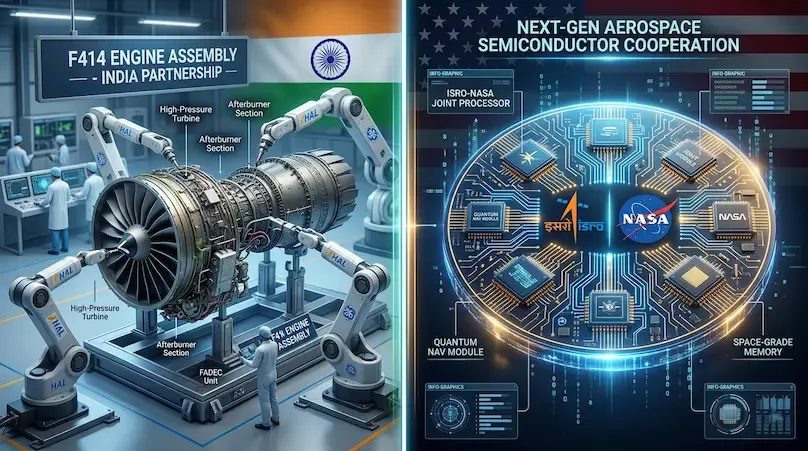
- GE F414 Engine Co-production: The historic deal for Hindustan Aeronautics Limited (HAL) to manufacture GE F414 jet engines in India with 80% technology transfer is now in its active implementation phase, powering the Tejas Mk2.
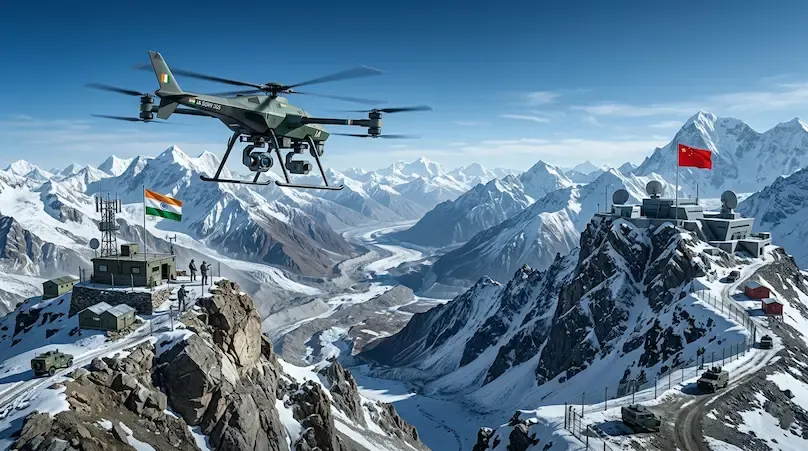
- MQ-9B Predator Drones: The induction of high-altitude long-endurance (HALE) drones has revolutionized India’s surveillance capabilities along the LAC and the Indian Ocean.
- Indus-X Progress: The India-US Defence Acceleration Ecosystem (Indus-X) has successfully incubated over 50 startups by 2026, focusing on undersea domain awareness and AI-led battlefield management.
3. Critical & Emerging Technology (iCET): The New Frontier
The Initiative on Critical and Emerging Technology (iCET) is the heartbeat of the 2026 partnership, removing regulatory barriers that previously hindered high-tech cooperation.
- Semiconductor Dominance: Major US firms like Micron and Applied Materials have operationalized their massive assembly and testing facilities in Gujarat, making India a vital node in the global chip supply chain.
- Space Collaboration: Building on the Artemis Accords, ISRO and NASA are preparing for a joint mission to the International Space Station (ISS) later in 2026, while also collaborating on the NISAR satellite for advanced earth observation.
- AI & Quantum Computing: Joint research centers in Bengaluru and Silicon Valley are now co-developing "Responsible AI" frameworks and quantum communication protocols to secure democratic digital infrastructure.
4. Trade & Economics: Reaching the $200 Billion Milestone
In 2026, the US remains India’s largest trading partner, with bilateral trade surpassing the $200 Billion mark.
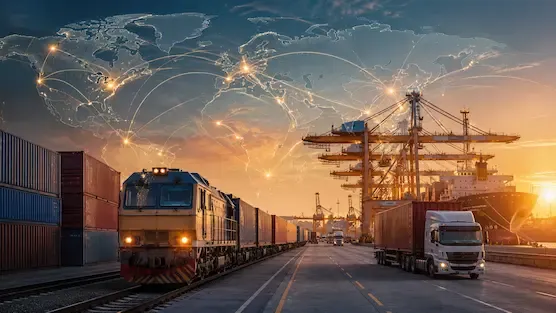
- Friend-Shoring Success: Thousands of US companies have shifted portions of their supply chains from East Asia to India, particularly in telecommunications and pharmaceuticals.
- Energy Partnership: India has increased its intake of US Liquefied Natural Gas (LNG) and coking coal, while the US is investing heavily in India's Green Hydrogen and solar manufacturing sectors.
- Investment Flows: US Foreign Direct Investment (FDI) into India has hit record levels in 2026, particularly in the e-commerce, fintech, and renewable energy sectors.
5. The Geopolitical Nexus: The Quad and Indo-Pacific Security
The strategic alignment between New Delhi and Washington is most visible in the maritime domain.
- Quad Solidarity: In 2026, the Quad (India, US, Japan, Australia) has moved from talk to action, launching the "Indo-Pacific Partnership for Maritime Domain Awareness" to track "dark shipping" and illegal fishing.
- Security Architecture: While India maintains its "Strategic Autonomy," its interoperability with the US Navy is at an all-time high, with frequent joint exercises like Malabar becoming more complex and intelligence-heavy.
6. The Talent Bridge: Diaspora, Visas, and the "Brain Gain" of 2026
In 2026, the 4.5 million-strong Indian-American community has transitioned from being a "successful minority" to a "strategic asset" for both nations.
- The CEO Diplomacy: With Indian-origin CEOs leading nearly 30% of Fortune 500 tech companies in 2026, the "Living Bridge" is now a boardroom reality. These leaders are instrumental in directing US investment toward India's emerging tech hubs in Pune, Hyderabad, and Bengaluru.
- Visa Modernization: Following years of friction, 2026 has seen the implementation of "In-Country H-1B Renewals." This allows Indian professionals to renew their work visas without leaving the US, reducing personal stress and ensuring business continuity for US tech giants.
- The Rise of "Brain Gain": A significant trend in 2026 is the return of high-tier Indian talent from Silicon Valley to lead Indian deep-tech startups. This "Reverse Brain Drain" is being supported by joint US-India venture capital funds, ensuring that the innovation cycle remains bilateral.
- Student Mobility: Over 300,000 Indian students are studying in the US in 2026, but the flow is becoming two-way. Several US universities have opened "Satellite Campuses" in India's GIFT City, creating a unified educational standard.
7. The Clean Energy Transition: A Green Strategic Partnership
Climate change is no longer just an environmental issue in 2026; it is a core pillar of India-US trade and security.
- Small Modular Reactors (SMRs): A landmark agreement in early 2026 has cleared the path for US-based firms to co-develop Small Modular Reactors in India. These provide a clean, safe, and scalable nuclear energy solution to power India’s massive data centers.
- Battery Storage & Supply Chains: To break the global monopoly on battery minerals, India and the US have formed a "Critical Minerals Club." They are co-investing in lithium and cobalt mining projects in South America and Africa, ensuring a steady supply for India’s booming EV industry.
- Hydrogen Hubs: US investment is fueling India’s ambition to become a global Green Hydrogen exporter. By May 2026, several joint ventures are operational in Gujarat and Odisha, combining US electrolyzer technology with India’s low-cost solar power.
- The Solar Alliance: The US has officially become a primary partner in the India-led International Solar Alliance (ISA), providing technical expertise to bring solar grids to developing nations in the Indo-Pacific.
8. Overcoming the "Irritants": Managing Diplomatic Friction in 2026
Even the best partnerships have friction. In 2026, New Delhi and Washington have mastered the art of "Disagreeing without Derailing."
- Strategic Autonomy vs. Alliances: India’s refusal to join a formal military alliance remains a point of discussion. However, the US in 2026 has accepted India’s "Multi-alignment" as a stabilizing force rather than a weakness.
- Data Localization & IPR: Disputes over data privacy laws and pharmaceutical patents continue to be negotiated. The "2+2 Ministerial Dialogue" has become the primary venue for resolving these trade "irritants" through compromise rather than sanctions.
- Regional Divergence: While they align on China, their views on certain West Asian and Eurasian conflicts sometimes differ. The 2026 approach is based on "Strategic Transparency"—keeping each other informed to prevent public diplomatic fallout.
9. Global Healthcare & the "Pharmacy of the World" 2.0
The COVID-19 era taught the world a lesson that India and the US are institutionalizing in 2026.
- The Quad Vaccine Partnership: This initiative has matured into a permanent "Bio-Security Shield." US-funded R&D combined with Indian mass-manufacturing is now producing affordable vaccines for a range of tropical diseases, serving the entire Global South.
- Genomic Research: Joint laboratories are working on "Genomic Mapping" to identify disease vulnerabilities in diverse populations, leading to the next generation of personalized medicine.
- Digital Health Stack: India is exporting its "Co-WIN" style digital health infrastructure to other nations with US financial backing, creating a transparent and efficient global health monitoring system.
10. "Third Country" Cooperation: A New Development Model
In 2026, India and the US are not just looking at each other; they are looking at the world together.
- Focus on Africa and Southeast Asia: The two nations are co-financing infrastructure projects—roads, ports, and digital grids—in developing countries. This provides a "Transparent Alternative" to high-interest, debt-trap loans offered by other regional powers.
- Agricultural Security: The "India-US Agriculture Knowledge Initiative" is being exported to African nations, using Indian farming techniques and US satellite data to ensure food security in the face of climate change.
- Disaster Relief: The two navies now conduct joint Humanitarian Assistance and Disaster Relief (HADR) missions across the Indian Ocean, proving that their partnership is a “Force for Good.”
As we the verdict for 2026 is clear: The India–US relationship has moved from "Engagement" to "Integration." Whether it is the F414 jet engines being built in Indian factories, joint satellite missions in orbit, or the shared vision of a free Indo-Pacific, the synergy is undeniable.
For the readers of Akhand News, this partnership represents more than just politics; it represents the future of jobs, technology, and national security. While challenges remain, the structural foundation laid in 2026 ensures that this alliance will remain the most consequential partnership of the 21st century.
Also Read: India–China Relations 2026: Navigating the Himalayan Deadlock and Trade Dependency