
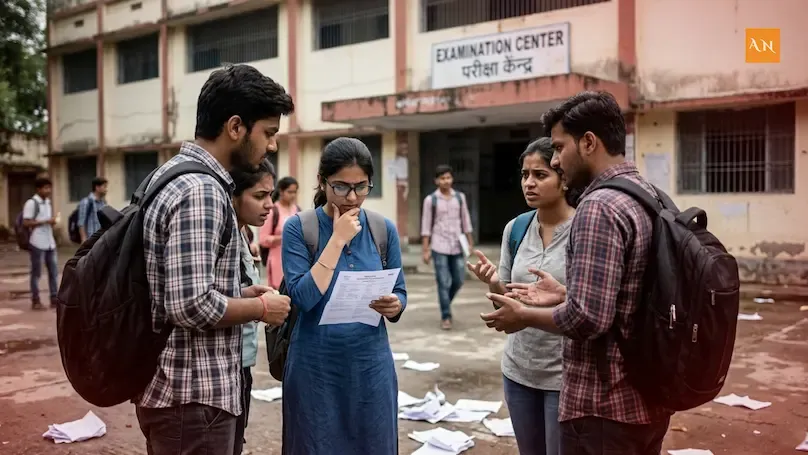
Indian students outside exam center holding admit cards, concerned after NEET UG 2026 cancellation news
In a cramped study room in Pune, 18-year-old Sakshi sits surrounded by thick NCERT textbooks, tears blurring her vision. For two years, her life revolved around a strict 14-hour study schedule, aiming for a prestigious government medical seat.
Today, her efforts feel completely worthless. Following explosive allegations of an organized paper leak network spanning multiple states, the National Testing Agency (NTA) officially cancelled the NEET UG 2026 examination, leaving nearly 23 lakh students students trapped in uncertainty.
This massive controversy has not only derailed the country's medical admission calendar but has also shattered the public's trust in India's premier testing infrastructure.
Also Read: UPSC Opens Applications for Specialized Direct Recruitment Posts
How the Paper Leak Network Exposed the System
The crisis first flared up in Rajasthan, where local police and special investigation units intercepted digital copies of suspicious "guess papers" circulating on encrypted messaging apps hours before the exam.
What initially seemed like localized malpractice turned into a national conspiracy when preliminary forensic scans revealed that the leaked questions exactly matched the official set.
With rumors suggesting that leaked papers were sold to desperate brokers for amounts reportedly ranging from ₹10 lakh to ₹25 lakh, the central government swiftly handed the entire probe over to the Central Bureau of Investigation (CBI).
Medical aspirants and student unions across major hubs like Mumbai and Delhi report intense mental exhaustion. Honest students who scored exceptionally well in the initial attempt feel penalized, arguing that the system has failed to protect their hard work from organized cheating syndicates.
The Logistics of the Upcoming Re-Exam
To contain the public outrage, the NTA has confirmed that a fresh nationwide re-test will be organized. While the administration has reassured students that existing application credentials remain valid and no fresh registration fees will be charged, the delayed announcement of the revised exam dates has kept the student community on edge.
Academic sessions, counseling timelines, and university schedules are bound to face a massive domino effect, pushing the entire medical batch of 2026 into an overlapping winter semester.
Education policy experts point out that conducting a leak-proof exam for 23 lakh candidates a second time is an major logistical challenge.
The government must immediately pivot from physical logistics to secure digital infrastructure, including advanced biometric filters and AI-monitored surveillance, to restore institutional credibility.
Also Read: The Education Shift of 2026: Top 10 High-Paying Careers and Skills That Degrees Can’t Teach You
The Search for Permanent Solutions
The CBI's expanding multi-state investigation is currently focusing on internal supply chain vulnerabilities, examining how highly secure question vaults were compromised before reaching the designated exam centers.
Officials familiar with discussions between state medical councils and central education regulators said both sides are expected to accelerate implementation of a stricter legislative framework in the coming months to impose non-bailable criminal penalties on paper-leak cartels.
When an examination as critical as NEET UG is compromised, it is not just a leak of a question paper; it is a leak of India’s healthcare future. A student's merit cannot be held hostage by dark-web brokers and systemic negligence. While a fair re-exam is the immediate bandage, the long-term cure demands a comprehensive and secure digital overhaul of our national competitive testing system.