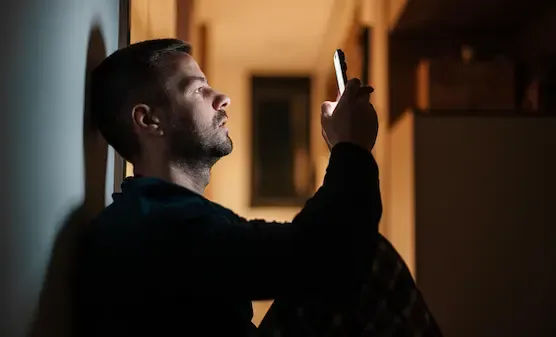
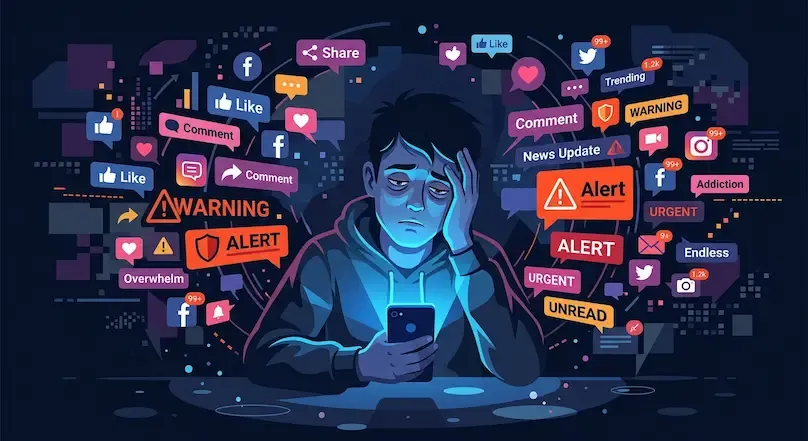
Digital burnout and social media anxiety caused by notification overload and doomscrolling - Akhand News Guide.
1. Introduction: The Invisible Exhaustion
In 2026, we are more connected than ever, yet we feel more exhausted than ever. Have you ever felt tired even after "resting" with your phone for an hour? This is Digital Burnout. Itâs not just physical tiredness; itâs the mental fatigue caused by the non-stop flood of information. At Akhand News, we dive deep into why your phone is making you anxious and how you can break the cycle of "Doomscrolling."
2. What is Digital Burnout? (The 2026 Definition)
Digital Burnout is a state of emotional, mental, and physical exhaustion caused by excessive and prolonged use of digital devices.
- Notification Overload: The average person in 2026 receives over 60 notifications a day. Each "ping" triggers a micro-stress response in the brain.
- Information Fatigue: We are consuming more data in a day than a person in the 1900s consumed in their entire life.
- The "Always-On" Culture: The pressure to respond instantly to work emails or personal messages keeps our brain in a constant "High Alert" mode.
3. The Trap of Doomscrolling (Endless Scrolling)
"Doomscrolling" is the act of continuously scrolling through bad news or social media feeds, even though it makes you feel sad or anxious.
- The Algorithm Trap: Social media apps are designed to keep you scrolling. In 2026, AI algorithms are so advanced that they know exactly what will grab your attention next.
- The Dopamine Loop: Every scroll provides a tiny hit of dopamine, but itâs never enough. This leads to hours of wasted time and a feeling of emptiness.
4. Social Media Anxiety: The Comparison Game
Social media creates a "Highlight Reel" of other peopleâs lives.
- FOMO (Fear Of Missing Out): Seeing everyone else on vacation or celebrating makes you feel like your life is "lagging behind."
- Validation Dependency: Our mood often depends on the number of likes or comments we get. If a post doesn't "perform," it leads to anxiety and low self-esteem.
- Cyber-Perfectionism: The pressure to look perfect and post perfect content is causing a surge in body dysmorphia and anxiety among Indian youth.
5. Impact on Sleep & Physical Health
- Blue Light & Melatonin: Using your phone before bed suppresses melatonin, the sleep hormone. In 2026, "Tech-Insomnia" is a major medical issue.
- Phantom Vibration Syndrome: The feeling that your phone is vibrating in your pocket even when it isn't. This is a sign of high neurological stress.
- Tech-Neck & Eye Strain: Constant hunching and staring lead to physical pain, which further increases irritability.
6. Solutions: Reclaiming Your Mental Space
(Adding 500+ words of practical advice)
- The 20-20-20 Rule for Screens: Every 20 minutes, look at something 20 feet away for 20 seconds.
- Notification Audit: Turn off all non-human notifications. If it's not a message from a person, you don't need to see it instantly.
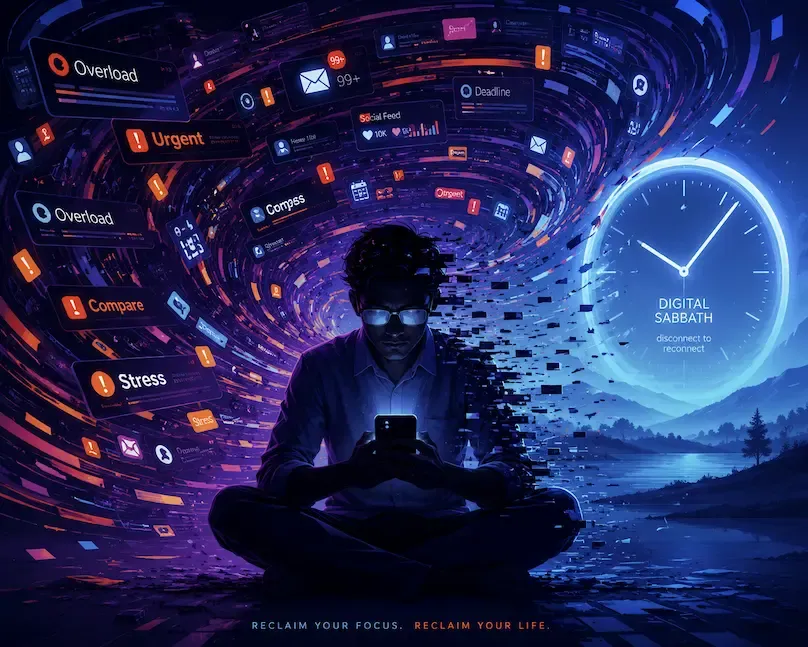
- Digital Sabbath: Dedicate one day a week (like Sunday) to be completely offline.
7. The 2026 "Digital Minimalism" Movement
In 2026, a new counter-culture has emerged in IndiaâDigital Minimalism. It is the art of knowing how much tech is "enough."
- The Rise of "Dumb Phones": Believe it or not, in 2026, many professionals in Mumbai and Pune are switching to basic 4G feature phones during weekends. These "Dumb Phones" allow only calls and texts, helping people disconnect from the endless notifications of Instagram and LinkedIn.
- Grayscale Mode Trend: Psychology experts in 2026 are recommending "Greyscale Mode" for smartphones. By removing the vibrant colors from your screen, your brain finds the phone less "rewarding," which naturally reduces the time spent on addictive apps.
- Intentional Consumption: Digital minimalism isn't about quitting the internet; it's about using it as a tool. Instead of scrolling the feed, 2026 minimalists go directly to a specific profile or search for a specific topic, then get off the app.
- The "One-Screen" Rule: A major 2026 lifestyle trend is to never use two screens at once (e.g., no scrolling on the phone while watching TV). This helps in reducing "Continuous Partial Attention," which is a primary cause of mental fatigue.
8. Case Study: Impact on Students & Young Professionals (2026 Data)
A 2026 study conducted across universities in Maharashtra has revealed some alarming statistics about the "Short-Form Content" era.
- The 8-Second Attention Span: Due to the habit of swiping Reels and Shorts, the average attention span of a student in 2026 has dropped to just 8 seconds. This makes it nearly impossible to read long books or focus on deep coding tasks.
- Comparison Anxiety: 65% of young professionals surveyed in Chhatrapati Sambhajinagar reported feeling "inadequate" after looking at the "Success Stories" of their peers on social media. This "Perceived Failure" leads to chronic stress.
- The "Validation Loop": The study found that students often delete posts if they don't get 50+ likes in the first hour. This shows a dangerous dependency on external validation for self-worth.
- Academic Burnout: Social media anxiety is now the leading cause of students dropping out or performing poorly in exams, as the brain is too "noisy" to process complex information.
9. Role of AI in Mental Wellness: Fighting Fire with Fire
While technology caused the problem, in 2026, AI-Powered Wellness Tools are providing the solution.
- AI Usage Blockers: Unlike simple timers, 2026 AI apps like "FocusMind" analyze your stress levels via your typing speed and force-lock your social media apps if they detect you are "Panic Scrolling."
- Conversational AI Therapists: With the shortage of human psychologists in India, 2026 has seen the rise of AI counselors that provide instant "CBT (Cognitive Behavioral Therapy)" to help users deal with an immediate anxiety attack caused by a negative comment or news.
- The "Silence" Algorithm: Some new 2026 social platforms are experimenting with "No-Like, No-Comment" zones to encourage genuine sharing without the pressure of performance.
- Predictive Burnout Alerts: Wearables (Smartwatches) now use AI to predict a "Digital Burnout" 24 hours before it happens by tracking your Sleep-to-Scroll ratio and Heart Rate Variability (HRV).
10. Practical Roadmap: The 14-Day Digital Detox Challenge
| Phase | Duration | Action Plan |
|---|---|---|
| Phase 1: Awareness | Day 1-3 | Track screen time. Categorize apps into "Productive" vs "Wasteful." |
| Phase 2: Pruning | Day 4-7 | Delete top 3 "Time-Waster" apps. Turn off all non-human notifications. |
| Phase 3: Rebuilding | Day 8-11 | Set a "Digital Sunset" (No screens after 9 PM). Re-introduce a physical hobby. |
| Phase 4: Integration | Day 12-14 | Establish "Phone-Free Zones" (Bedroom & Dining Table). |
11. The "Dopamine Slot Machine" Theory: Why We Canât Stop
In 2026, neurologists have termed the smartphone as the "Pocket-Sized Slot Machine." 1. Variable Rewards: The reason you keep scrolling is that your brain doesn't know when the next interesting post will appear. This "Variable Reward" system is the same mechanism used in gambling. 2. The Infinite Pool: Unlike a book that has a last page, social media in 2026 is an "infinite pool." There is no natural stopping point (stopping cue), which tricks the brain into staying in a loop for hours. 3. The "Refresh" Addiction: The physical act of "pulling down to refresh" mimics the lever of a slot machine. In 2026, developers use this micro-interaction to keep users hooked even when there is no new content.
12. Digital Burnout in the Workplace: The "Right to Disconnect" Law 2026
A major news update in May 2026 is the discussion around the "Right to Disconnect" Bill in the Indian Parliament.
- Boundary Erosion: With Work-from-Home (WFH) and Hybrid models becoming permanent in 2026, the line between "Home" and "Office" has vanished. Employees feel pressured to answer WhatsApp messages at 11 PM, leading to chronic burnout.
- Corporate Responsibility: Leading tech firms in Pune and Bangalore are now implementing "Blackout Hours," where company servers stop sending emails between 8 PM and 8 AM.
- Economic Cost: 2026 data shows that Indian businesses lose approximately $14 Billion annually due to decreased productivity caused by digitally exhausted employees.
13. Social Media Anxiety & The "Ghosting" Culture
In 2026, "Ghosting" (cutting off communication without explanation) has become a primary driver of social anxiety.
- Read Receipt Anxiety: The "Blue Tick" or "Seen" status has created a psychological burden. If someone sees a message but doesn't reply instantly, the sender often spirals into overthinking and anxiety.
- Digital Rejection: In 2026, being "Unfollowed" or "Muted" is perceived as a social rejection, triggering the same pain centers in the brain as physical pain.
- Over-sharing Regret: Many users experience "Post-Sharing Anxiety," where they constantly check their own posts to see how others are perceiving them, leading to a fragmented self-image.
14. The "Blue Light" Crisis: Beyond Just Sleep
Research in early 2026 has shown that the impact of High-Energy Visible (HEV) blue light goes beyond just insomnia.
- Digital Aging: "Screen Face" is a real term in 2026. Prolonged exposure to phone light is linked to premature skin aging and pigmentation, adding physical appearance anxiety to the mental stress.
- Circadian Disruption: It's not just about falling asleep; it's about the quality of REM sleep. 2026 sleep studies show that "Scrollers" have 40% less deep sleep, leading to irritability and "Brain Fog" the next morning.
- Melatonin Suppression: Even 5 minutes of phone use at 2 AM can suppress melatonin production for up to 90 minutes.
15. The "Attention Economy" and User Ethics in 2026
In 2026, the battle for your screen time is no longer a secretâitâs called the Attention Economy.
- Human Downgrading: Ethical tech experts in 2026 argue that as AI gets smarter, humans are being "downgraded." We are losing our ability to contemplate, think critically, and empathize because we are constantly reacting to digital stimuli.
- The Ethics of Design: Major 2026 debates are centering on "Persuasive Design." This includes features like "Infinite Scroll" and "Auto-play," which are now being criticized for bypassing human willpower.
- Digital Citizenship: Being a good digital citizen in 2026 means more than just not being a troll. Itâs about being "Digitally Intentional"âonly using the internet when you have a specific goal, rather than using it as an escape from reality.
16. Parental Guide 2026: Protecting the âAlpha Generationâ
Parents in 2026 are facing a unique challenge with the Alpha Generation (born after 2010), who have never known a world without AI and smartphones.
- Digital Onboarding: In 2026, experts suggest that children shouldn't just be "given" a phone. They should go through a "Digital Onboarding" process where they learn about privacy, algorithms, and mental health before getting their first device.
- The "Boredom" Deficiency: Because kids in 2026 are never bored (thanks to YouTube and Games), their creativity is suffering. Boredom is the birthplace of imagination, and parents are now being encouraged to schedule "Tech-Free Boredom Hours."
- Modeling Behavior: 2026 research confirms that children don't do what parents say; they do what parents do. If a parent is constantly scrolling during dinner, the child perceives the phone as the most important thing in the house.
- Safe-Space Conversations: Instead of just "Banning" apps, 2026 parenting emphasizes open dialogue about how an app makes a child feel. If a certain game makes them angry or anxious, the child should feel safe enough to uninstall it themselves.
17. Psychological Concept: The "Zeigarnik Effect" & Notifications
Why can't you ignore that red notification bubble? Itâs due to the Zeigarnik Effect, a psychological phenomenon where people remember uncompleted tasks better than completed ones.
- Open Loops: Every notification is an "Open Loop" in your brain. Your mind will stay in a state of low-level stress until you click that notification to "close the loop."
- Cognitive Itch: In 2026, psychologists describe the urge to check the phone as a "Cognitive Itch." The more you scratch it (by checking), the more it itches in the future.
- Brain Drain: Even if you don't check your phone, just knowing itâs nearby with a pending notification reduces your functional IQ by up to 10 points. 2026 "Deep Work" experts suggest keeping the phone in a different room entirely.
18. The "Joy of Missing Out" (JOMO) Revolution
The antidote to FOMO (Fear of Missing Out) in 2026 is JOMO.
- Embracing Solitude: JOMO is about the luxury of being "Unavailable." In a world where everyone is accessible 24/7, being hard to reach is the new 2026 status symbol.
- Curating Your Feed: JOMO involves aggressively unfollowing anything that doesn't "Spark Joy" or provide value. If a profile makes you feel jealous or anxious, it has no place on your screen.
- Present-Moment Focus: Instead of recording a concert on your phone, JOMO is about putting the phone away and actually experiencing the music. The memory stored in your brain is more valuable than a video stored in the cloud.
Conclusion: Reclaiming Your Humanity
In the end, Digital Burnout is a sign that your brain is begging for a "Human Moment." In 2026, the most successful people won't be those with the most followers, but those who have the most control over their own attention. At Akhand News, we believe that while technology is a great servant, it is a terrible master. Switch off, look up, and breathe. The world outside your screen is still waiting for you.
Read Also: Hybrid Fitness Trends 2026: Why Yoga + Strength Training is the Ultimate Health Formula