
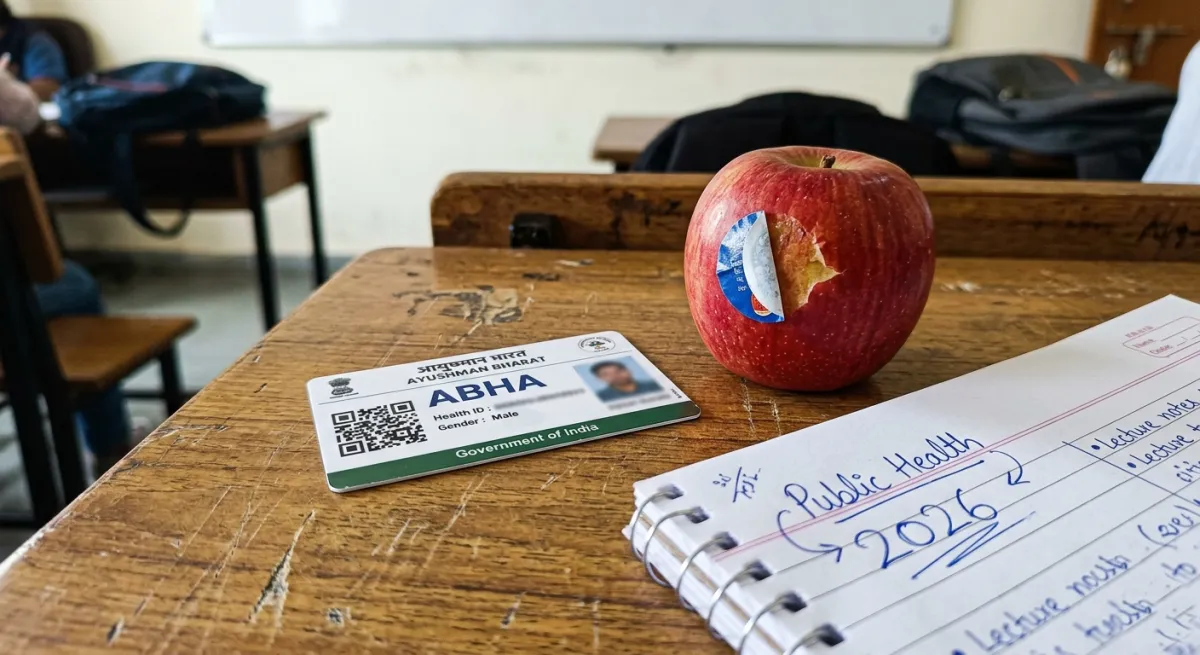
Bridging Knowledge: Policy meets practice in India's 2026 healthcare mission.
Introduction: As of April 3, 2026, India’s healthcare landscape is undergoing a data-driven transformation. With World Health Day (April 7) approaching under the global theme “Stand with Science,” the Ministry of Health and FSSAI have issued critical updates that balance financial inclusivity with preventive safety.
Section 1: The Policy Pillar – Ayushman Bharat 2.0
The Government of India has significantly broadened the scope of the Pradhan Mantri Jan Arogya Yojana (PM-JAY) for the 2025-26 period.
- Senior Citizen Inclusion: In a major policy shift, all individuals aged 70 and above are now entitled to a ₹5 Lakh annual cover, regardless of their income bracket.
- Digital Integration: The ABHA (Ayushman Bharat Health Account) is now mandatory for seamless records. It uses a 14-digit unique ID to create a longitudinal health record for every citizen.
- Infrastructure Investment: Under the PM-ABHIM (Health Infrastructure Mission), a total outlay of ₹64,180 Crore is being utilized to build 17,788 urban and rural health centers (Ayushman Arogya Mandirs) by the end of 2026.
Section 2: Food Safety Science – The Sticker Controversy
The Food Safety and Standards Authority of India (FSSAI) has issued a technical alert regarding the use of non-food grade stickers on fruits and vegetables.
- The Chemical Concern: Most stickers use synthetic adhesives containing Phthalates and other polymer-based glues. If consumed, these can act as endocrine disruptors.
- Migration Risk: Chemicals from the adhesive can "migrate" through the skin of the fruit into the pulp, especially in soft-skinned fruits like apples and pears.
- Safe Practice: FSSAI mandates that even "food-grade" stickers must be removed, and the area underneath should be peeled or cut to avoid chemical residue ingestion.
Section 3: Global Health Context – "One Health" Initiative
Coinciding with the G7 Presidency’s International One Health Summit (April 2026), India is intensifying its surveillance on zoonotic diseases (diseases spreading from animals to humans).
- H5N1 Surveillance: Following avian deaths in South India, the "One Health" framework is being used to integrate human, animal, and environmental data to prevent a potential spillover.
Conclusion: For the students and educators of Akhand News, these updates represent a move toward a more "Resilient Healthcare System." Understanding the shift from reactive treatment to proactive prevention (through policy and food safety) is essential for the next generation of medical and public health professionals.
Source: Ministry of Health & Family Welfare (MoHFW), FSSAI Statutory Regulations, WHO Campaign Desk 2026.