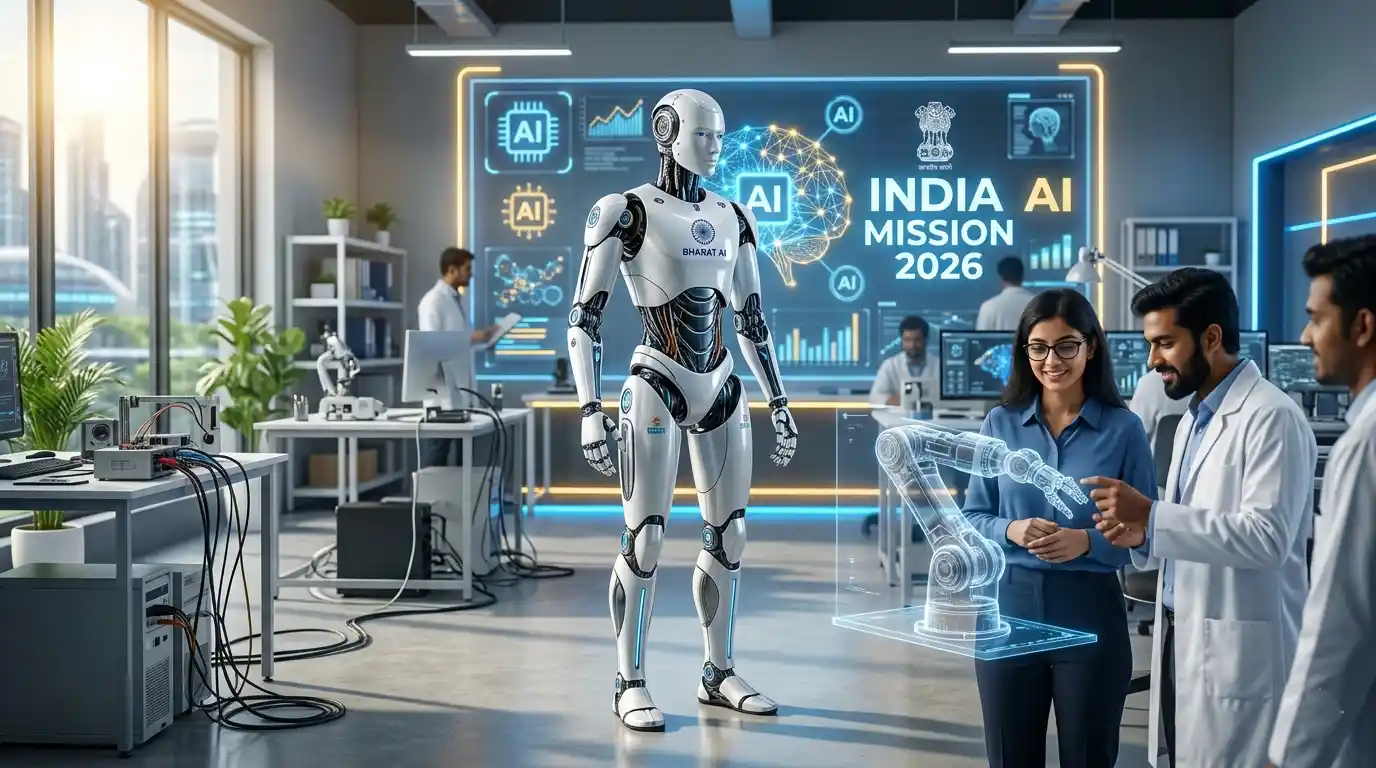
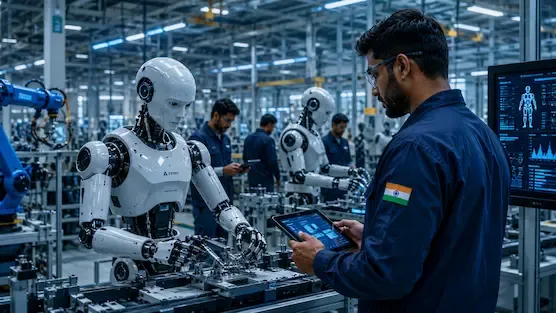
Humanoid AI robots and smart automation systems inside an advanced Indian technology workplace representative image.
Step into a high-tech automobile assembly line on the outskirts of Pune, or a premium multi-speciality hospital in Bengaluru, and you might encounter a coworker that doesn't breathe, complain, or take coffee breaks. Standing five feet tall, with smooth metallic limbs and facial cameras that track movement with pinpoint accuracy, AI-powered humanoid robots are beginning to enter select Indian workplaces and pilot industrial environments. What was once confined to the pages of sci-fi novels is now a rapidly accelerating rapidly growing robotics sector across Indian tech hubs.
As global manufacturing supply chains shift toward automation, Indian deep-tech startups and government research bodies are racing to build indigenous humanoids tailored specifically for domestic industries.
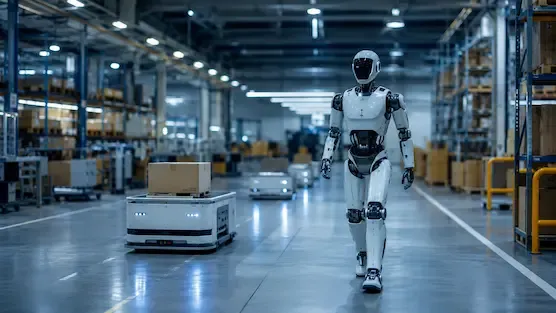
The drive to deploy humanoids is moving at an unprecedented pace across three major sectors: heavy manufacturing, healthcare, and public administration. In warehouse logistics and automotive plants, engineering firms are using humanoids equipped with advanced Computer Vision to handle hazardous materials, pick up heavy components, and perform repetitive quality-control checks that often cause human injuries.
Also Read: The Robotics Dawn 2026: How AI-Powered Humanoids are Redefining Daily Life and Industry
Meanwhile, the healthcare sector is integrating these machines to manage patient reception, deliver precise medical inventories inside quarantine zones, and assist senior citizens with basic mobility, allowing human nursing staff to focus on critical medical care.
Factory supervisors in industrial zones like Chhatrapati Sambhajinagar note that the goal is not to completely replace human workers, but to create a 'Co-botics' ecosystem. By letting humanoid robots handle high-risk, high-temperature tasks, factories have seen a factories report improved operational safety and efficiency in automated environments and a substantial increase in operational efficiency.
What makes this current wave different is the integration of advanced localized Generative AI. India's upcoming space humanoid, 'Vyommitra'—developed by ISRO to mimic human functions in microgravity—has proven that Indian engineers can build world-class robotic systems natively.
Following this blueprint, private robotics firms are now training their humanoids on regional Indian languages, enabling these machines to interact naturally with rural citizens at bank helpdesks, railway stations, and government offices.
Robotics policy analysts believe that India’s vast availability of open-source AI data and skilled software talent gives it a distinct cost advantage. If local hardware manufacturing scales up, Indian-made humanoids could gradually become more accessible for SMEs if domestic hardware costs decline, making them accessible to small and medium enterprises (SMEs) that cannot afford expensive Western automation models.
Despite the rapid progress, building a reliable humanoid is an immense engineering challenge. Perfecting bipedal locomotion—allowing a robot to walk smoothly on uneven Indian roads or crowded factory corridors without tripping—requires complex kinetic sensors and high-torque actuators that are currently expensive to import.
Officials familiar with the discussions between industrial tech consortiums and national science academies said both sides are expected to accelerate implementation of specialized robotics manufacturing clusters in the coming months to reduce dependency on foreign hardware components.
Humanoid robots entering our daily lives is an inevitable technological transition, not a distant dream. While concerns regarding automated job displacement are natural, history shows that every technological leap creates entirely new industries. India’s focus must remain on upskilling its young workforce to design, command, and maintain these machines, ensuring we don't just consume technology.
As robotics and generative AI continue to converge, India’s long-term success will depend not just on adopting automation, but on building the engineering talent and manufacturing ecosystem required to lead it.