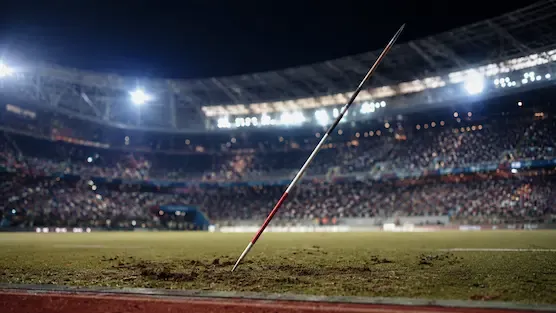
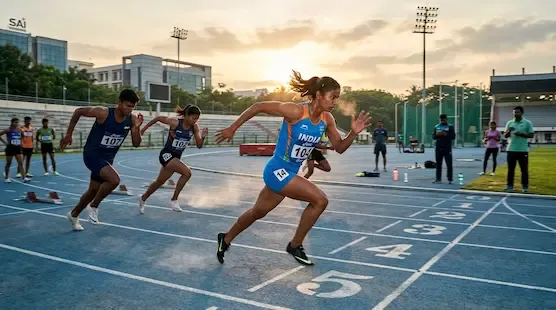
Young Indian athletes training on a running track during an early morning athletics practice session at a sports academy representative image.
At 5:10 AM inside a synthetic running track on the outskirts of Patiala, dozens of young athletes are already deep into sprint drills before sunrise. Some are training barefoot. Others are wearing worn-out spikes stitched together for one more season.
Yet despite the modest conditions, one thing has fundamentally changed inside Indian athletics over the last few years: belief.
For decades, track and field in India existed far away from the national spotlight, buried beneath cricket’s overwhelming cultural dominance. Athletics only briefly entered public conversation during Olympic seasons before fading back into obscurity.
Today, however, a silent transformation is unfolding.
From javelin throw and steeplechase to sprint relays and long-distance running, Indian athletics is slowly evolving from an underfunded survival sport into a serious international ambition.
The Post-Neeraj Chopra Effect
The biggest catalyst behind this shift has undoubtedly been the historic Olympic success of Neeraj Chopra.
His global victories did far more than win medals — they permanently altered the psychology of Indian athletics itself.
For the first time, young athletes across small towns and rural academies began believing that Olympic-level success was realistically achievable outside cricket. Coaches across Haryana, Punjab, Maharashtra, and Uttar Pradesh report a visible increase in youth participation in field events after Chopra’s rise transformed athletics into a viable career aspiration.
The impact also extended financially.
Corporate sponsorships, government funding, sports-science investments, and private athletic academies began receiving significantly higher attention after India’s Olympic breakthroughs demonstrated global medal potential.
India’s New Focus: Speed, Endurance, and Science
Modern athletics is no longer driven purely by raw talent.
Today’s elite track-and-field ecosystem revolves around:
- sports biomechanics,
- recovery science,
- nutrition planning,
- AI-assisted performance tracking,
- high-altitude conditioning,
- and injury management systems.
India’s athletic infrastructure is gradually adapting to this reality.
Training centers in Patiala, Bhubaneswar, Bengaluru, and Trivandrum are increasingly integrating modern sports-science methodologies once accessible only to elite Western programs.
This transformation is especially visible in sprinting and middle-distance events where Indian athletes are beginning to close historic performance gaps.
The Rise of Grassroots Running Culture
Interestingly, one of the biggest drivers behind athletics awareness is not professional competition itself — it is India’s exploding amateur fitness movement.
Marathons, city runs, obstacle races, and endurance events are witnessing record participation across urban India. What earlier existed as niche fitness activities for elite runners has now become mainstream among working professionals and students.
This expanding running culture is slowly strengthening the grassroots ecosystem for athletics itself.
Sports development analysts believe this matters enormously because countries with strong athletic cultures are usually built from mass participation first — elite champions emerge later.
Also Read: IPL 2026 Points Table: Rajasthan Royals Dominate at No. 1; Delhi Capitals and PBKS Follow
The Financial Reality Still Remains Brutal
Yet beneath the optimism, Indian athletics still faces severe structural challenges.
Outside a small group of internationally recognized athletes, thousands of competitors continue struggling with:
- inadequate training facilities,
- inconsistent sponsorship support,
- limited financial security,
- poor rehabilitation infrastructure,
- and unstable career opportunities after retirement.
Many athletes still rely heavily on government jobs through sports quotas for long-term stability.
The pressure becomes especially intense for competitors from rural or economically weaker backgrounds where a failed athletic career can place entire families under financial stress.
The Olympic Pressure Building Ahead
As India aggressively pushes its ambition to become a global sporting power, athletics is expected to remain at the center of national medal expectations heading toward future Olympic cycles.
Government sports bodies are increasingly emphasizing:
- grassroots talent identification,
- district-level athletic scouting,
- women’s participation,
- nutrition programs,
- and international exposure training.
Officials familiar with ongoing sports development discussions indicate that India is likely to continue expanding private-public athletic partnerships in the coming years to strengthen Olympic preparation pipelines.
Akhand News Viewpoint:
India’s athletics revolution is not just about medals — it is about changing the country’s sporting identity itself. For decades, young Indian athletes grew up believing that global sporting greatness belonged only to other nations. That mental barrier is finally beginning to crack. But true sporting transformation cannot depend on a few superstar names alone.
A serious athletics culture requires long-term investment in coaching, nutrition, infrastructure, and athlete dignity at every level. If India genuinely wants to become a sporting superpower, the future will not be built only inside cricket stadiums — it will also be built quietly on running tracks before sunrise.
Disclaimer: This article is intended for informational and educational purposes only. Athletic performance, sports development policies, and training systems discussed in this article are based on publicly available trends, expert opinions, and current developments within Indian athletics.