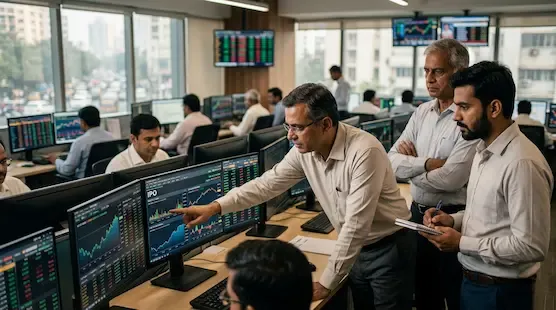
Indian retail investors tracking IPO performance and stock market listings on digital trading platforms.
Not long ago, India’s stock market was witnessing a remarkable spectacle.
The announcement of a new Initial Public Offering (IPO) often triggered a wave of excitement across financial markets. Retail investors rushed to apply through mobile trading apps, social media influencers aggressively promoted listing-day opportunities, and subscription figures regularly crossed extraordinary levels within hours.
For many first-time investors, IPO investing began to feel like a guaranteed shortcut to quick profits.
But the mood has changed.
Across India’s financial markets, a noticeable slowdown is unfolding inside the IPO ecosystem. Retail participation has cooled, subscription enthusiasm has weakened, and investors who once chased nearly every new listing are becoming increasingly selective.
The era of automatic IPO euphoria appears to be fading.
The shift did not happen overnight.
During the post-pandemic market boom, abundant liquidity, rising retail participation, and strong equity returns created a powerful environment for IPO activity. Companies from technology, fintech, consumer services, manufacturing, and digital commerce sectors entered the public markets at aggressive valuations.
For a period, listing-day gains became almost expected.
Many investors entered IPOs less for long-term ownership and more for short-term listing profits. Oversubscription numbers became headlines, while social media communities transformed IPO investing into a mass retail phenomenon.
Also Read: Market Pulse: Sensex Fights Back, But Gold Steals the Show at Record ₹82,000+
However, market conditions have gradually become more challenging.
Several recently listed companies have struggled to sustain their valuations after entering public markets. In some cases, stocks that debuted with strong excitement later slipped below their issue prices, leaving retail investors facing unexpected losses.
The experience has fundamentally altered investor behavior.
The question is no longer simply, “Will this IPO get subscribed?”
The question is increasingly, “Is this company actually worth the valuation being offered?”
One of the biggest changes inside the market is the growing maturity of retail participation.
Unlike earlier cycles where brand visibility and media attention alone could generate overwhelming demand, investors are now paying closer attention to fundamentals.
Profitability, debt levels, revenue quality, cash flow sustainability, and long-term business models are receiving greater scrutiny.
Financial advisors note that many investors who experienced disappointing post-listing performance over the last few years have become significantly more cautious about chasing high-profile offerings without deeper analysis.
The rise of financial education content, market awareness, and digital research platforms has also contributed to this shift.
Retail investors today have access to far more information than previous generations.
As a result, market enthusiasm is gradually being replaced by valuation discipline.
Also Read: Silence Before the Storm? Markets Closed for Good Friday as Crude Oil Hits $105
At the center of the IPO slowdown lies a larger debate surrounding pricing.
Many market participants argue that certain companies entering public markets have attempted to maximize valuations during favorable conditions, leaving limited room for post-listing appreciation.
When investors believe that growth expectations are already fully priced into the offering, demand naturally becomes more restrained.
This dynamic has become especially visible in sectors where future profitability remains uncertain despite strong growth narratives.
Investors are increasingly questioning whether revenue expansion alone justifies premium valuations.
The market appears to be sending a clear message:
Growth stories still matter, but profitability and execution matter more.
The cooling IPO environment does not necessarily indicate weakness.
In many ways, it may represent a healthier phase of market evolution.
Financial analysts argue that excessive speculation often creates unsustainable cycles where investor enthusiasm becomes disconnected from business reality. A more selective market forces companies to improve transparency, strengthen financial performance, and justify their valuations more carefully before approaching public investors.
For retail participants, this shift encourages a more disciplined investment culture.
Rather than treating IPOs as short-term trading opportunities, investors are increasingly evaluating them as long-term ownership decisions.
This represents a significant psychological transformation inside India’s rapidly expanding equity market.
Also Read: Market Marvel: Sensex & Nifty Scale New All-Time Highs as FY 2026-27 Begins
Even as global market volatility and foreign capital movements continue influencing sentiment, domestic retail investors remain one of the strongest pillars supporting Indian financial markets.
Systematic Investment Plan (SIP) inflows into mutual funds continue reflecting strong long-term participation from households across the country.
This suggests that investor confidence in equities has not disappeared.
Instead, confidence is becoming more selective.
Investors are not necessarily abandoning markets.
They are simply becoming more careful about where they place their money.
The future of India’s IPO market will likely depend on a combination of factors including corporate earnings quality, valuation discipline, interest rate conditions, economic growth expectations, and broader market sentiment.
Companies with strong balance sheets, sustainable business models, and realistic pricing strategies are expected to continue attracting investor attention.
However, the days when nearly every public offering could rely purely on market excitement may be coming to an end.
The market is entering a phase where credibility matters more than hype.
The slowdown in IPO enthusiasm should not be viewed as a negative signal for India’s financial markets.
In reality, it may be a sign of growing market maturity.
A healthy stock market is not one where investors blindly chase every new listing. It is one where capital flows toward businesses that demonstrate genuine value creation, financial discipline, and long-term sustainability.
India’s retail investor revolution remains one of the most important financial developments of the last decade. But every mature investment culture eventually reaches a stage where excitement gives way to scrutiny.
That transition appears to be happening now.
The Great IPO Slowdown is not necessarily the story of investors losing confidence.
It may simply be the story of investors becoming wiser.