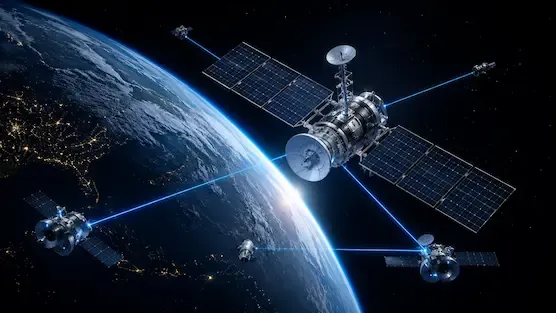
Advanced space communication satellite connecting multiple spacecraft through a next-generation orbital network.
Space exploration has always depended on one critical factor that often receives less attention than rockets, spacecraft, or astronauts: communication.
No matter how advanced a mission becomes, it cannot succeed without a reliable way to send commands, receive scientific data, and maintain contact with spacecraft operating millions of kilometers away from Earth. As humanity prepares for a new era of lunar exploration, commercial space stations, and eventual missions to Mars, communication technology is becoming just as important as propulsion systems.
This week, NASA announced a significant advancement that could reshape the future of space operations. Engineers successfully demonstrated a new communications capability that allows spacecraft to seamlessly switch between different space communication networks, reducing dependence on a single system and improving reliability for future missions.
While the development may sound technical, experts believe it could become one of the most important building blocks for the next generation of human and robotic exploration beyond Earth.
Why Space Communication Matters
Every spacecraft depends on a constant flow of information.
Commands sent from Earth tell spacecraft what to do, while onboard instruments continuously transmit scientific observations, images, and system status reports back to mission control. Even a brief disruption can affect operations, especially during complex maneuvers such as planetary landings, lunar surface missions, or deep-space navigation.
Traditionally, many missions have relied on dedicated communication infrastructure designed for specific programs. Although these systems have served space agencies well for decades, future exploration plans are expected to involve a far larger number of spacecraft operating simultaneously.
NASA's Artemis missions, commercial lunar projects, Earth observation satellites, private space stations, and future Mars missions will all require robust communication networks capable of handling enormous volumes of data.
The challenge is no longer simply communicating with one spacecraft—it is creating an interconnected space communications ecosystem.
The New Breakthrough
NASA's latest demonstration focused on what engineers describe as "network interoperability."
In simple terms, the technology allows spacecraft to move between communication networks in a similar way that a smartphone can switch between different internet connections without interrupting service.
Instead of depending on a single communication pathway, future spacecraft could dynamically connect to multiple available networks depending on signal quality, mission requirements, and location.
The successful demonstration showed that data could continue flowing even while changing communication systems, creating a more flexible and resilient infrastructure for future missions.
For mission planners, this capability could significantly reduce operational risks while increasing overall efficiency.
Preparing for the Artemis Era
The timing of the breakthrough is particularly important.
NASA's Artemis program aims to establish a long-term human presence around and on the Moon. Unlike the Apollo era, future lunar operations will involve multiple spacecraft, orbiting stations, robotic landers, surface vehicles, and international partners working simultaneously.
Managing such a complex environment requires communication systems that can operate continuously across different platforms.
Engineers compare the challenge to building an internet for space—an interconnected network where spacecraft, satellites, and surface systems can communicate efficiently regardless of their manufacturer or mission operator.
The newly demonstrated technology represents an important step toward that vision.
Benefits Beyond the Moon
Although the immediate focus is lunar exploration, the implications extend much further.
Future Mars missions will require communication systems capable of operating over vast distances where delays and interruptions are more difficult to manage. Flexible network switching could help maintain more reliable links between spacecraft, orbiters, and Earth-based mission control.
Commercial space companies may also benefit.
Private operators are increasingly launching satellites, building communication constellations, and developing plans for orbital habitats. As commercial activity expands, standardized communication frameworks will become increasingly important for safety and coordination.
The ability to connect across different networks could help create a more collaborative space environment where government agencies and private companies share infrastructure more efficiently.
Also Read: Inside India’s Space-Tech Boom: Rockets, Satellites, and the New Innovation Frontier
Building the Space Internet
Many experts believe the long-term goal is something often referred to as the "Interplanetary Internet."
Unlike today's internet, which depends on near-instantaneous connections across Earth, future space networks must function across enormous distances where signals can take minutes—or even hours—to travel.
Developing such a system requires advanced routing, automation, and intelligent network management.
NASA's latest demonstration does not create an interplanetary internet overnight, but it addresses one of the foundational challenges: ensuring devices can communicate effectively across multiple independent networks.
Just as the early internet evolved from isolated computer systems into a global communications platform, future space infrastructure may gradually evolve into a unified network connecting Earth, the Moon, Mars, and beyond.
The Growing Importance of Space Infrastructure
The breakthrough also highlights a broader trend in the global space industry.
For decades, public attention focused primarily on launches and spacecraft. Today, however, infrastructure is becoming increasingly important. Communication networks, navigation systems, orbital servicing technologies, and data management platforms are emerging as critical components of future exploration.
Countries and private companies investing in these foundational technologies could play major roles in shaping the next chapter of the space economy.
Reliable communication systems will be essential not only for scientific discovery but also for commercial operations, resource utilization, and eventually long-term human settlements beyond Earth.
Space exploration is entering a new phase where success will depend not only on reaching distant destinations but also on staying connected once we get there.
NASA's latest communication breakthrough may not generate the same excitement as a rocket launch or a lunar landing, but its long-term significance could be just as important. By creating more flexible and resilient communication networks, engineers are laying the groundwork for a future in which spacecraft, astronauts, and scientific instruments operate as part of an interconnected space ecosystem.
As humanity moves toward permanent lunar operations and future Mars missions, innovations like these may quietly become the technologies that make deep-space exploration possible.