
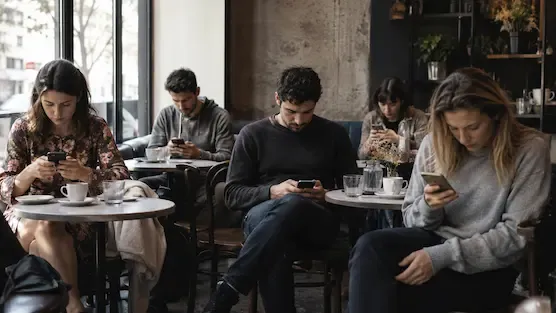
People sitting together in a café while individually focused on smartphones instead of real conversation.
The first thing many people touch every morning is no longer sunlight, water, or even another human being.
It is a smartphone.
Before getting out of bed, millions of people instinctively check notifications, social media feeds, emails, videos, messages, and news updates. What appears to be a small daily habit has quietly evolved into one of the biggest behavioural shifts of the modern era.
Smartphones have changed how people communicate, work, shop, learn, travel, and entertain themselves. But beneath the convenience and connectivity, experts increasingly warn that excessive digital dependence may also be changing human attention spans, emotional health, relationships, sleep quality, and even the ability to remain mentally present.
The transformation is happening so gradually that many people no longer notice it.
The Human Attention Span Is Under Pressure
One of the biggest concerns surrounding smartphone overuse is the growing collapse of sustained attention.
Modern apps are designed to constantly capture and retain user engagement through notifications, infinite scrolling, short-form videos, algorithmic recommendations, and instant rewards. As a result, many people now struggle to focus for long periods without checking their phones.
Researchers have increasingly linked excessive screen exposure with declining concentration and rising cognitive fatigue. Studies suggest constant multitasking between apps, messages, videos, and digital content may weaken deep focus over time. (frontiersin.org)
Also Read: Yoga for Digital Detox 2026: Achieving Mental & Physical Balance in a Hyper-Connected World
This behavioural shift is visible almost everywhere:
- students studying while switching between apps
- employees checking phones during meetings
- families eating together while scrolling separately
- people unable to sit quietly without digital stimulation
The mind is becoming continuously occupied, but rarely fully focused.
Social Media Is Reshaping Emotional Behaviour
Smartphones themselves are not the only issue. The digital ecosystems attached to them are equally influential.
Social media platforms increasingly shape how people think about success, beauty, relationships, productivity, and happiness. Constant exposure to idealized lifestyles and carefully edited online identities often creates unhealthy comparison.
Mental health professionals say this comparison culture is contributing to rising stress, anxiety, loneliness, and self-esteem issues among both teenagers and adults. (news18.com)
Many users unconsciously begin measuring their lives against the highlight reels of strangers online.
The result is a strange contradiction:
people are more digitally connected than ever before, yet many feel emotionally disconnected in real life.
Sleep Is Quietly Being Damaged
Late-night smartphone use has become another major concern.
Medical experts warn that excessive screen exposure before sleep affects melatonin production and disrupts natural sleep cycles. Blue light exposure, emotional overstimulation, and endless scrolling habits often make it harder for the brain to properly rest. (sleepfoundation.org)
Across cities and smaller towns alike, many people now sleep later, wake up tired, and remain mentally exhausted throughout the day.
Poor sleep does not only affect energy levels. It can also influence:
- memory
- emotional stability
- concentration
- productivity
- heart health
- mental wellbeing
Yet many people continue carrying phones directly into bed every night without recognizing the long-term consequences.
Dopamine and the “Always Busy” Feeling
Behavioural researchers increasingly compare excessive smartphone use to a continuous stimulation cycle.
Every notification, message, like, or short video creates small dopamine-driven reward responses inside the brain. Over time, this can condition people to constantly seek digital stimulation, making silence or boredom feel uncomfortable.
This explains why many individuals instinctively unlock their phones repeatedly without any clear reason.
The behaviour often becomes automatic.
People may check their phones:
- during conversations
- while eating
- while studying
- during work
- while walking
- even during moments meant for relaxation
Ironically, constant stimulation often leaves people mentally more exhausted instead of emotionally refreshed.
Relationships Are Also Changing
One of the most visible changes caused by smartphone culture is the decline of uninterrupted human interaction.
Conversations are shorter.
Attention is fragmented.
People physically present together are often mentally elsewhere.
Psychologists increasingly warn that excessive phone dependence can weaken emotional presence inside friendships, families, and relationships. Even brief interruptions caused by phones during conversations can reduce emotional connection and trust over time. (apa.org)
In many households, silence has not increased because people have nothing to say.
It has increased because everyone is looking at separate screens.
Technology Is Not the Enemy
Despite these concerns, experts also emphasize an important point:
Smartphones themselves are not inherently harmful.
They have transformed healthcare access, emergency communication, education, digital payments, remote work, navigation, and business opportunities. Millions of people depend on smartphones daily for productivity and learning.
The real issue is imbalance.
Technology becomes harmful when it replaces rest, attention, emotional presence, and healthy routines rather than supporting them.
So What Is the Solution?
Most experts agree that digital balance — not total digital rejection — is the healthiest long-term approach.
Simple behavioural changes can significantly improve mental wellbeing:
- reducing unnecessary screen time
- avoiding phones before sleep
- taking regular offline breaks
- spending time outdoors
- focusing on face-to-face conversations
- disabling excessive notifications
- practicing uninterrupted work periods
- limiting endless scrolling habits
Many mental health professionals also recommend creating “phone-free zones” during meals, family time, and sleep hours.
Most importantly, people need to become conscious users instead of unconscious consumers of technology.
Perhaps the biggest challenge of the smartphone era is this:
Are people still controlling technology —
or is technology increasingly controlling human behaviour?
Modern life has become faster, louder, and more digitally connected than ever before. But human attention, emotional wellbeing, and mental peace were never designed for nonstop stimulation.
As smartphone dependence quietly grows across society, the future may not depend only on better technology.
It may also depend on whether human beings can relearn how to disconnect, slow down, focus deeply, and remain emotionally present in a constantly distracted world.
Smartphones have undoubtedly improved modern life in countless ways.
But convenience without balance can slowly become dependence.
The growing attention crisis, emotional exhaustion, sleep disruption, and digital overstimulation seen across society are not isolated problems anymore. They are becoming part of everyday life for millions of people.
The challenge is no longer whether technology will continue advancing.
The real challenge is whether people can continue protecting their mental peace, relationships, and human attention while living inside an increasingly digital world.