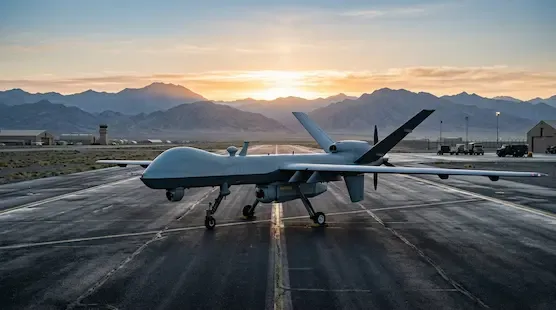
Modern surveillance drone representing the growing role of advanced technology in national security representative image.
For decades, the image of military strength was often defined by tanks rolling across open fields, fighter jets dominating the skies, and massive naval fleets guarding coastlines. While those symbols remain important, defence experts around the world increasingly believe that the future of security may depend on machines small enough to fit inside the back of a military vehicle.
Drones, formally known as unmanned aerial systems, have quietly transformed from specialized surveillance tools into one of the most influential technologies in modern defence planning. Their growing role extends far beyond combat operations. Today, they are used for border monitoring, disaster response, infrastructure inspection, maritime surveillance, search-and-rescue missions, and emergency logistics.
The rapid evolution of drone technology reflects a much larger change in the way countries think about national security.
Also Read: Inside India’s Underwater Defence Strategy as Maritime Threats Rise in the Indian Ocean
A New Kind of Battlefield
Modern security challenges are becoming more complex. Nations are not only protecting physical borders but also monitoring vast coastlines, critical infrastructure, and remote regions that can be difficult to access quickly through conventional means.
In many situations, drones provide an efficient solution. Equipped with advanced cameras, thermal imaging systems, and real-time communication technology, they can monitor large areas while reducing operational risks for personnel on the ground.
Defence analysts often point out that the value of drones lies not simply in their ability to fly, but in the speed at which they collect and transmit information. In an environment where decisions often depend on real-time intelligence, situational awareness can be just as important as traditional military hardware.
Technology Beyond Defence
The growing importance of drones is not limited to military organizations.
Many of the same technologies are now being used in civilian sectors. Emergency responders use aerial systems to assess flood-affected regions. Forest departments monitor wildlife habitats from above. Infrastructure agencies inspect bridges, highways, and power lines without exposing workers to unnecessary risks.
This overlap between civilian innovation and defence applications has encouraged governments and private industries to invest heavily in research and domestic manufacturing capabilities.
Experts believe that the countries leading the next generation of autonomous technologies may also strengthen their long-term strategic resilience.
The Rise of Indigenous Innovation
Across the world, governments are increasingly encouraging local technology ecosystems to develop advanced unmanned systems. Domestic production reduces dependence on external suppliers while supporting innovation, skilled employment, and industrial growth.
For emerging technology sectors, drones represent an important intersection of engineering, artificial intelligence, communications systems, and advanced manufacturing.
The development of indigenous capabilities is therefore often viewed not only as a security objective but also as an economic opportunity.
As drone technology becomes more accessible, policymakers also face new regulatory challenges. Questions surrounding airspace management, privacy protection, and safe civilian operations have become increasingly important.
Experts argue that the long-term success of this technology will depend on maintaining a careful balance between encouraging innovation and establishing responsible operational standards.
Building public trust may prove just as important as developing new capabilities.
Also Read: Operation Sindoor: How India Shifted from Diplomatic Statements to Decisive Military Action
The story of modern defence is no longer defined solely by the size of an army or the number of aircraft in a fleet. Increasingly, it is about information, precision, and technological adaptability.
Drones represent a broader transformation taking place across the global security landscape—one where intelligent systems support human decision-making rather than replace it.
As technology continues to reshape the future of national security, the most significant advantage may belong not simply to those with the largest resources, but to those who can innovate, adapt, and respond to new challenges with speed and responsibility.