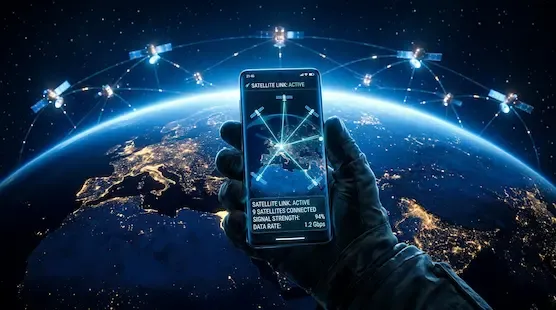
Futuristic smartphone connected to low-Earth orbit communication satellites symbolizing next-generation satellite mobile networks. Image Representative
Mobile networks depended almost entirely on towers built on the ground.
If a person moved too far from those towers into mountains, forests, oceans, deserts, or remote highways connectivity simply disappeared. “No signal” became a normal limitation of modern smartphones.
That limitation may now be entering its final phase.
In 2026, the global telecom industry is rapidly accelerating toward one of the biggest shifts in mobile communication history: direct satellite connectivity for ordinary smartphones. What was once considered futuristic emergency technology is now evolving into a large-scale commercial race involving telecom operators, smartphone companies, satellite firms, and governments across multiple continents.
The goal is ambitious: allow standard smartphones to connect directly with satellites in space without requiring special antennas or additional hardware.
And according to industry analysts, that transformation is no longer theoretical.
The Satellite-to-Phone Race Has Intensified
Over the past year, the telecom sector has moved aggressively from limited pilot programs toward commercial deployment of direct-to-device satellite communication systems.
At Mobile World Congress 2026, industry discussions increasingly focused on “non-terrestrial networks” — systems designed to integrate satellites directly into everyday mobile communication infrastructure. Analysts at S&P Global noted that the industry has now shifted “from hype to commercial reality.”
The technology is commonly referred to as:
- Direct-to-Cell
- Direct-to-Device (D2D)
- Satellite-to-Mobile Connectivity
Unlike traditional satellite phones, these systems are designed to work with ordinary mass-market smartphones.
This is what makes the development so important.
Samsung Expands Satellite Communication Support
One of the clearest signs of the industry shift came from Samsung.
Earlier this year, Samsung officially announced expanded satellite communication support for select Galaxy smartphones, including the Galaxy S26 series, through partnerships with telecom operators across North America, Europe, and Japan.
The company described satellite communication as part of “next-generation connectivity” and linked the expansion to the growing role of AI and digital infrastructure.
Unlike earlier emergency-only systems, newer satellite integrations are gradually expanding toward:
- text messaging
- voice communication
- limited mobile data
- emergency services
- remote-area connectivity
Industry experts believe this represents the beginning of a much larger transition where satellite coverage becomes an invisible backup layer for standard cellular networks.
Starlink, AST SpaceMobile and the New Telecom Battle
The biggest competition in this sector is currently unfolding between companies such as:
- SpaceX Starlink
- AST SpaceMobile
- telecom carrier alliances
- regional satellite operators
AST SpaceMobile has become one of the most closely watched companies in the race. The company is building what it describes as the world’s first space-based cellular broadband network designed for standard smartphones without hardware modifications.
In April 2026, the U.S. Federal Communications Commission granted AST commercial authorization for direct-to-device satellite services using low-band cellular spectrum through partnerships with Verizon, AT&T, and FirstNet.
Meanwhile, Starlink’s Direct-to-Cell technology is also expanding rapidly through telecom partnerships. In the United Kingdom, Virgin Media O2 recently launched a Starlink-powered satellite-to-mobile service aimed at reducing rural “not-spots” where traditional mobile signals remain weak.
The broader telecom industry is now treating satellite integration not as a niche emergency feature but as a long-term infrastructure strategy.
Why Telecom Companies Are Investing So Aggressively
The reason is simple:
billions of people still experience coverage gaps.
Even in technologically advanced countries, remote highways, mountains, forests, villages, oceans, and rural zones often remain outside reliable network coverage.
Satellite-to-smartphone systems could eventually help eliminate many of those dead zones.
TrendForce estimates the global direct-to-cell market may grow nearly 49% year-over-year in 2026, reaching approximately $7.6 billion.
Telecom firms increasingly view satellite integration as valuable for:
- emergency communication
- disaster resilience
- maritime connectivity
- rural internet access
- aviation communication
- military and public safety systems
Several experts also believe satellite integration could become extremely important during natural disasters when traditional telecom infrastructure fails.
Also Read: Inside India’s Underwater Defence Strategy as Maritime Threats Rise in the Indian Ocean
The Technology Was Once Considered Nearly Impossible
For years, engineers believed ordinary smartphones could not reliably communicate directly with satellites hundreds of kilometers above Earth.
Smartphones were originally designed for nearby terrestrial towers — not fast-moving satellites in low-Earth orbit.
Recent advances in: low-Earth orbit (LEO) satellites, signal processing, 5G standards, beamforming, antenna optimization have slowly changed that assumption.
Research papers published in recent years now describe satellite-smartphone integration as a major transition toward future 6G connectivity systems.
Some researchers believe future telecom systems may eventually combine: terrestrial 5G,satellite broadband, direct emergency fallback systems into a single unified global network.
India Could Become a Major Market
India may eventually become one of the largest markets for satellite-mobile connectivity.
Large rural populations, remote terrain, infrastructure gaps, and growing smartphone penetration create strong long-term demand for expanded connectivity solutions.
The country is already seeing increased interest in satellite communication partnerships involving telecom operators and global space companies. Industry analysts expect India’s future telecom policies to play a major role in determining how quickly satellite-smartphone systems scale commercially.
For millions of users living in regions with unstable network access, satellite-enabled smartphones could eventually improve communication reliability significantly.
But Major Challenges Still Remain
Despite rapid progress, experts warn that the technology is still evolving.
Several limitations remain: slower speeds compared to terrestrial 5G, high infrastructure costs, regulatory approvals, spectrum coordination, satellite congestion, battery optimization,weather-related, performance issues
Analysts at S&P Global recently noted that direct-to-device systems may initially remain focused mainly on messaging and emergency services rather than fully replacing traditional mobile broadband.
However, the pace of investment suggests the industry believes the technology will improve rapidly over the next several years.
The integration of satellite connectivity into ordinary smartphones may become one of the most important telecom transformations since the arrival of mobile internet itself.
For decades, mobile communication depended entirely on physical towers built on Earth.
Now, the telecom industry is beginning to extend that network into space.
The larger significance is not only technological.
It is human.
Because for billions of people living beyond reliable coverage zones, future smartphones may no longer ask:
“Is there a tower nearby?”
Instead, the answer may eventually come directly from the sky.