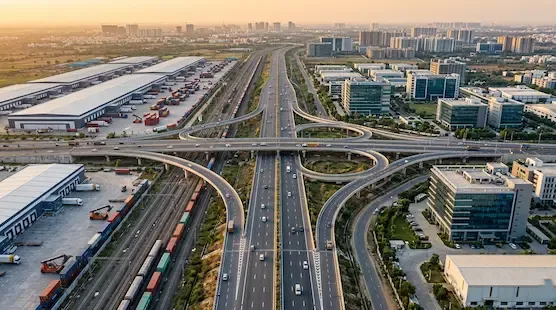
Modern transportation infrastructure including highways, railways and logistics networks supporting economic growth in India representative image.
A few years ago, infrastructure was largely viewed as a long-term policy objective discussed in government reports, budget speeches, and economic planning documents.
Today, it has become one of the most visible indicators of India's growth story.
From high-speed expressways and dedicated freight corridors to expanding airports, metro rail systems, logistics parks, and modern railway stations, infrastructure projects are transforming both urban and rural landscapes at a pace rarely seen before.
For policymakers, infrastructure represents more than construction activity. It is increasingly being positioned as a catalyst for economic growth, job creation, industrial expansion, and regional connectivity.
As India pursues its ambition of becoming a larger global economic power, the country's infrastructure race is emerging as one of the defining stories of its development journey.
Building the Foundations of Growth
Economists have long argued that infrastructure serves as the backbone of economic activity.
Efficient transportation networks reduce logistics costs. Reliable connectivity improves business productivity. Modern ports, railways, and airports strengthen trade competitiveness.
For businesses, infrastructure directly influences operational efficiency.
A manufacturer transporting goods across states, a farmer accessing larger markets, or a technology company expanding into emerging regions all depend on physical infrastructure to support growth.
Also Read: The Digital Nation: How Technology Is Reshaping India's Economic Future
This connection between infrastructure and economic performance has driven significant public investment in roads, railways, logistics, and urban mobility projects across the country.
The Expressway Revolution
One of the most visible aspects of India's infrastructure expansion has been the rapid development of highway and expressway networks.
New corridors are reducing travel times between major economic centers, improving freight movement, and strengthening regional connectivity.
For businesses, time savings often translate into lower transportation costs and improved supply-chain efficiency.
For consumers, enhanced road infrastructure can improve access to services, employment opportunities, and markets.
Infrastructure experts note that the impact of modern transport corridors often extends far beyond transportation itself, influencing real estate development, industrial investment, and regional economic activity.
Railways and Logistics Transformation
The modernization of railway infrastructure is also playing a central role in India's growth strategy.
Dedicated freight corridors, station redevelopment projects, and ongoing railway upgrades aim to improve efficiency while supporting increasing cargo and passenger demand.
Logistics remains a critical factor in economic competitiveness.
Reducing transportation delays and improving cargo movement can significantly influence business costs and productivity.
Also Read: From Memes to Movement: How Cockroach Janta Party Captured India’s Gen-Z Frustration
Industry analysts suggest that improvements in logistics infrastructure could strengthen India's manufacturing ambitions by enhancing supply-chain reliability and market access.
Airports, Cities, and Connectivity
India's aviation sector has experienced substantial growth over the past decade, driving investment in airport expansion and modernization.
New airports and terminal upgrades are increasing connectivity between cities while supporting tourism, trade, and regional development.
Urban infrastructure is also evolving.
Metro rail projects, smart city initiatives, public transportation improvements, and digital infrastructure investments are reshaping how millions of people move, work, and interact within growing urban centers.
As cities continue expanding, infrastructure planning is becoming increasingly important to maintaining economic efficiency and quality of life.
Large-scale infrastructure projects also create significant economic activity beyond the construction sector itself.
Roads, railways, airports, and industrial corridors generate demand across multiple industries, including engineering, manufacturing, logistics, construction materials, technology, and professional services.
The multiplier effect of infrastructure investment is often cited as one of its strongest economic advantages.
When projects create jobs, improve connectivity, and attract private investment simultaneously, their impact can extend across entire regional economies.
This explains why infrastructure spending frequently occupies a central position in long-term economic development strategies.
Despite significant progress, infrastructure expansion remains a complex undertaking.
Also Read: From Indus Valley to 2047: VP Radhakrishnan Launches Sudha Murty’s Book on Parliament’s Mural Legacy
Land acquisition, environmental clearances, financing requirements, project execution timelines, and coordination among multiple stakeholders continue to present challenges.
Experts emphasize that the success of infrastructure development depends not only on announcing projects but also on ensuring timely completion, efficient utilization, and long-term sustainability.
Balancing growth objectives with environmental considerations and community concerns remains an important policy priority.
The focus increasingly extends beyond construction toward operational efficiency and long-term value creation.
Infrastructure is no longer being viewed solely as a public works initiative.
It is increasingly being treated as an economic strategy.
Countries seeking sustained growth often invest heavily in transportation networks, logistics systems, urban development, and industrial connectivity.
India's ongoing infrastructure expansion reflects this broader approach.
The objective is not merely to build roads, airports, or rail lines. It is to create a framework that supports productivity, investment, trade, and economic resilience over the coming decades.
The long-term success of this strategy will depend on how effectively these assets integrate into the broader economy
Infrastructure rarely generates the same headlines as elections, markets, or major corporate announcements.
Yet its impact often proves far more lasting.
A new highway, railway corridor, airport, or logistics hub can influence economic activity for decades, shaping investment decisions, employment opportunities, and regional development.
India's infrastructure push represents one of the country's most ambitious growth initiatives in recent history. The challenge now lies in maintaining execution quality, improving efficiency, and ensuring that development remains inclusive and sustainable.
The true measure of success will not be the number of projects announced.
It will be how effectively those projects improve everyday lives and strengthen India's long-term economic foundations.