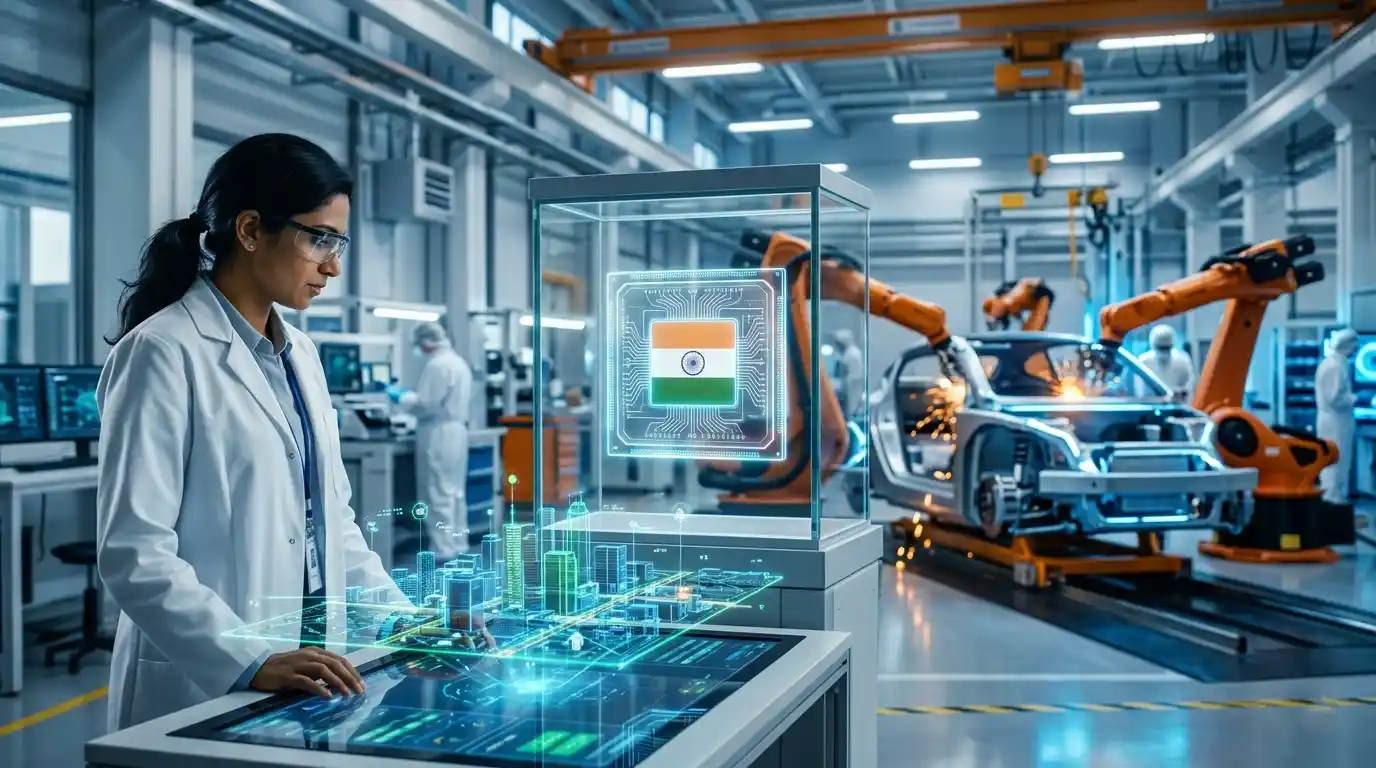

Corporate executives and engineers reviewing AI-powered business analytics inside a modern technology office.
Artificial intelligence is no longer being treated as an experimental technology inside corporate boardrooms.
Across India's business landscape, companies are now restructuring operations, increasing investments, redesigning services, and even changing workforce strategies around AI-driven transformation. What began as isolated pilot projects only a few years ago is rapidly evolving into a full-scale corporate shift that is influencing technology, finance, manufacturing, consulting, infrastructure, and enterprise operations.
For corporate India, 2026 is increasingly becoming the year when AI moved from strategy presentations to real operational deployment.
The transition is reshaping how companies compete, allocate budgets, hire talent, and define long-term growth.
Until recently, many large enterprises approached artificial intelligence cautiously.
Most organizations experimented with limited AI pilots focused on automation, analytics, or customer service. However, global competition and rapid advances in generative AI have accelerated adoption dramatically.
Industry analysts now say companies are under pressure to integrate AI not as a side initiative, but as a central business capability.
Deloitte's recent banking and capital markets outlook noted that many enterprises are moving beyond fragmented AI projects toward full-scale AI-powered operational models, although challenges related to governance, infrastructure, and compliance remain significant.
The shift is particularly visible in India's technology sector, where major firms are aggressively expanding AI-related capabilities.
Also Read: The AI Restructuring Wave: How Automation Is Changing India’s Tech Workforce
Infosys, Wipro and the AI Race
India's largest technology companies are increasingly positioning themselves around enterprise AI transformation.
Infosys recently announced a strategic collaboration with OpenAI aimed at accelerating enterprise AI deployment through its Topaz platform and OpenAI's advanced models. The partnership focuses on helping enterprises move from AI experimentation toward scalable production environments.
The company also reported strong FY26 performance, crossing $20 billion in annual revenue while highlighting AI-driven enterprise transformation as a major growth engine.
Meanwhile, Wipro launched a dedicated AI-Native Business & Platforms Unit designed to accelerate enterprise AI adoption and develop AI-driven business models. The company described the move as preparation for a future where "services as software" becomes increasingly important.
Corporate analysts believe these developments show how AI is becoming central to India's IT services industry rather than remaining an optional innovation layer.
Beyond software and consulting, AI infrastructure itself is becoming a major investment category.
Recent reports indicate that billions of dollars are now flowing into data centers, AI cloud services, semiconductor capabilities, and enterprise computing systems linked to artificial intelligence demand.
One of the biggest developments came through a reported $2 billion AI infrastructure arrangement involving Gorilla Technology and Supermicro for India's Yotta AI infrastructure project.
Separately, AirTrunk announced plans linked to a massive long-term data center expansion strategy in India, highlighting how AI demand is increasing pressure on cloud and digital infrastructure capacity.
Experts say the AI economy will require not only software innovation but also enormous physical infrastructure investments involving power, cooling systems, semiconductor supply chains, and high-performance computing facilities.
Also Read: Corporate India Ends Hybrid Work as Return-to-Office Policies Tighten
Startups Are Also Shifting Toward Sustainable AI Models
India's startup ecosystem is experiencing similar changes.
Instead of focusing only on valuations and aggressive expansion, many AI startups are now emphasizing infrastructure-led business models and operational sustainability.
Ola Krutrim, India's first AI unicorn, recently reported profitability in FY26 after pivoting toward domestic AI cloud services. According to reports, the company achieved strong revenue growth while focusing on enterprise AI infrastructure rather than purely experimental AI development.
The trend reflects a broader change in investor expectations. Venture capital firms increasingly prefer companies that combine AI innovation with scalable revenue models and disciplined financial management.
AI adoption is also beginning to influence workforce planning.
Some global companies are openly redirecting budgets toward AI development and infrastructure expansion. Reports suggest certain firms are prioritizing AI investments even while controlling employee compensation growth or restructuring operational spending.
This does not necessarily mean AI is replacing entire workforces overnight. However, it does indicate that companies are reassessing how human labor, automation, and software-driven productivity interact inside modern organizations.
Industry experts increasingly believe future corporate competitiveness may depend on how effectively businesses integrate human expertise with AI-assisted workflows.
Despite the rapid expansion, AI adoption is also creating new concerns around governance, transparency, cybersecurity, and risk management.
Academic research analyzing corporate AI disclosures has found a sharp rise in companies acknowledging AI-related risks in regulatory filings, particularly around fraud, cybersecurity, legal liability, and operational reliability.
As AI becomes more deeply embedded into enterprise operations, regulators and investors are expected to demand stronger oversight and clearer accountability standards.
This means corporate AI growth will likely be shaped not only by innovation but also by compliance and governance frameworks.
India's corporate sector is entering a defining transition period.
Artificial intelligence is no longer being viewed simply as a future technology trend. It is rapidly becoming a foundational layer across infrastructure, software, consulting, manufacturing, finance, and enterprise operations.
The companies that successfully balance innovation, profitability, workforce adaptation, and responsible AI governance may shape the next decade of India's business economy.
The AI race in corporate India has already begun. The next challenge will be determining which companies can convert technological ambition into sustainable long-term growth.