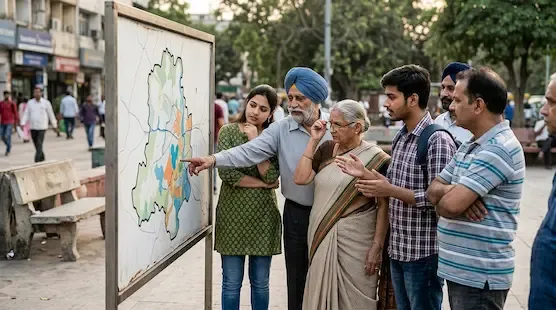
Indian citizens examining a map during a discussion about electoral representation and constituency boundaries in India representative image.
A political debate that could reshape the future of Indian democracy is quietly moving from constitutional discussions into the center of national politics.
At the heart of the conversation is a complex but highly consequential issue: delimitation.
For most voters, the term rarely enters everyday political discussions. Yet the decisions taken around delimitation in the coming years could influence how parliamentary seats are distributed, how states are represented in the Lok Sabha, and how political power is balanced across the country.
The issue has gained renewed national attention after recent debates surrounding parliamentary seat expansion, women’s reservation, and the future structure of electoral representation. While the immediate legislative proposals have faced political resistance, the larger question remains unresolved.
How should India redraw its political map in a country whose population has changed dramatically over the last five decades?
Delimitation is the process of redrawing the boundaries of parliamentary and assembly constituencies to reflect population changes.
The objective is simple in principle: ensure that elected representatives speak for roughly equal numbers of citizens.
However, in India, the issue is far more complicated.
The allocation of Lok Sabha seats among states has effectively remained frozen since the 1970s. Constitutional changes extended this freeze to encourage population control policies and to avoid penalizing states that successfully reduced population growth.
As a result, India's population has increased dramatically while the overall political map has remained largely unchanged.
Today, the country faces a fundamental democratic question: should parliamentary representation continue to follow older population figures, or should it be adjusted to reflect current demographics?
The controversy has intensified because any future delimitation exercise could significantly alter the balance of political representation between states.
States with faster population growth could gain additional parliamentary seats, while states that successfully controlled population growth fear a reduction in their relative influence within the Lok Sabha.
This concern has been particularly visible across several southern states, where political leaders have argued that successful population management should not result in reduced political weight at the national level.
Supporters of delimitation, however, argue that democratic representation must ultimately reflect population realities.
Their position is based on the principle of "one person, one vote," which suggests that parliamentary representation should evolve alongside demographic change.
The debate has therefore evolved into a larger discussion about democracy, federalism, and regional balance.
The issue became even more politically sensitive after discussions linking delimitation to the implementation of women's reservation in legislatures.
Also Read: PM Modi’s ‘Guarantee’ for Women: Special Parliament Session from April 16
The constitutional framework for women's reservation requires a fresh delimitation process before reserved seats can be operationalized. This has effectively tied two major political reforms together.
Supporters view this as an opportunity to modernize representation and increase women's participation in politics simultaneously.
Critics argue that combining the two issues risks turning a widely supported reform into a broader political conflict over seat distribution and regional representation.
For political parties, the implications are enormous.
A future redistribution of seats could influence electoral strategies, coalition arithmetic, campaign priorities, and long-term governance calculations.
Political analysts note that any significant change in parliamentary representation would not simply affect individual states. It could reshape the national electoral landscape itself.
Questions surrounding federal balance have therefore become central to the discussion.
Should representation be determined purely by population?
Should states that invested heavily in education, healthcare, and population stabilization be protected from losing influence?
Can a compromise formula satisfy both democratic representation and regional equity?
These questions remain unresolved.
Despite recent political disagreements, the broader issue has not disappeared.
Experts note that future census data and constitutional requirements will eventually bring delimitation back into national policymaking discussions. The debate may be delayed, but it is unlikely to vanish.
Any future attempt to redraw parliamentary representation will require substantial political consensus, given its long-term consequences for India's democratic structure.
The challenge for policymakers will be finding a framework that balances population-based representation with the concerns of states worried about preserving their political voice.
The delimitation debate is not merely about numbers, seats, or electoral boundaries.
It is fundamentally a debate about how India defines representation in the world's largest democracy.
On one side lies the democratic principle that every citizen's vote should carry equal weight. On the other lies the concern that states which successfully managed population growth should not find themselves politically disadvantaged as a result.
Neither argument can be dismissed easily.
The real challenge is not whether India should discuss delimitation. The challenge is whether the country can build a political consensus that protects democratic fairness while preserving federal balance.
The decisions taken in the coming years may not simply redraw constituency boundaries.
They could redefine the future shape of Indian politics itself.