
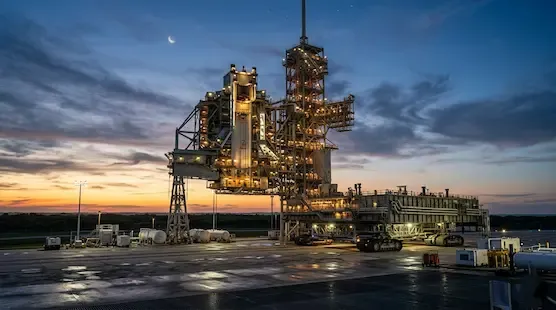
A detailed rocket stands on an illuminated launch pad at dusk against a dramatic sunset sky with a crescent moon representative image
For years, the idea sounded almost impossible.
A single individual becoming worth one trillion dollars seemed like something from science fiction — a number too large to realistically imagine in the modern economy. But in 2026, that milestone has officially been crossed.
Elon Musk, the billionaire entrepreneur behind SpaceX, Tesla, X, xAI, Neuralink, and several other technology ventures, has now become the world’s first trillionaire following the historic public market debut of SpaceX.
The moment marks one of the most extraordinary wealth expansions ever recorded in modern business history.
SpaceX IPO Changed Everything
The biggest trigger behind Musk’s historic wealth jump was the long-awaited SpaceX stock market debut.
According to market reports, SpaceX shares opened significantly above their IPO price and surged strongly during the company’s first trading session. The rally rapidly pushed SpaceX’s market valuation beyond $2 trillion, making it one of the most valuable companies in the world almost immediately after listing.
Because Musk controls a massive ownership stake in the company, the stock surge dramatically increased his personal net worth within hours.
Several international financial publications now estimate Musk’s fortune at approximately $1.1 trillion, officially making him the richest person in modern recorded history.
The jump reportedly added tens of billions of dollars to his wealth in a single trading day alone.
Also Read: The Future of Living: Top 5 Smart Cities in India to Invest in 2026 for Maximum Returns
From PayPal to a Trillion-Dollar Empire
Musk’s rise has unfolded across multiple industries over nearly three decades.
His early breakthrough came during the internet boom of the late 1990s with Zip2 and later X.com, which eventually evolved into PayPal. After PayPal was acquired by eBay, Musk reinvested much of his wealth into ventures that many investors initially considered extremely risky.
Those bets included:
- Tesla for electric vehicles
- SpaceX for private space exploration
- Neuralink for brain-computer interfaces
- The Boring Company for tunnel infrastructure
- xAI for artificial intelligence
- X (formerly Twitter) for social media and digital communications
At various points, several of these businesses faced criticism, financial instability, or predictions of failure.
Instead, many eventually became industry-defining companies.
SpaceX Became the Core of Musk’s Wealth
Although Tesla previously drove much of Musk’s fortune, analysts now say SpaceX has become the single biggest contributor to his net worth.
The company’s valuation has risen rapidly over the past two years as investors increasingly viewed SpaceX not simply as a rocket-launch company, but as a larger technology ecosystem involving:
- satellite internet through Starlink
- artificial intelligence integration
- military and government contracts
- space logistics
- commercial launches
- future Mars exploration ambitions
Reports suggest SpaceX’s valuation accelerated further after integrating AI-focused operations connected to xAI.
Investors appear increasingly willing to value the company not only on present revenue but also on long-term expectations surrounding space infrastructure and AI-driven communications systems.
The Largest IPO in Financial History
The SpaceX listing itself has already become historic.
According to financial reports, the IPO raised approximately $75 billion, making it the largest public offering ever recorded globally.
The debut immediately surpassed several previously famous IPOs, including:
- Saudi Aramco
- Alibaba
- Visa
- Meta (Facebook)
- Rivian
Analysts say the listing reflects the enormous investor appetite currently surrounding artificial intelligence, space technology, autonomous systems, and future infrastructure companies.
At the same time, some economists have warned that portions of the technology market may also be experiencing speculative excess linked to AI-driven investment enthusiasm.
A Symbol of the AI and Space Era
Musk’s trillion-dollar milestone also represents something much larger than personal wealth.
It reflects how dramatically global markets are now valuing technologies tied to:
- artificial intelligence
- automation
- autonomous mobility
- satellite networks
- advanced computing
- commercial space systems
In many ways, Musk has become one of the defining figures of the modern technology era — admired by supporters as a visionary innovator and criticized by others for controversial political statements, market volatility, and the enormous concentration of wealth.
Regardless of opinion, his influence on global technology industries is difficult to ignore.
Also Read: The AI Restructuring Wave: How Automation Is Changing India’s Tech Workforce
Critics Warn About Extreme Wealth Concentration
Musk’s trillionaire status has also intensified debates about wealth inequality.
Organizations including Oxfam recently argued that the rapid rise of ultra-billionaire fortunes highlights widening economic gaps worldwide. According to their analysis, Musk’s wealth growth over the past year averaged more than $1 million per minute.
Critics argue that such concentrations of wealth raise difficult questions about taxation, political influence, economic power, and the future structure of capitalism itself.
Supporters, however, argue that Musk’s fortune reflects investor belief in innovation, risk-taking, and long-term technological transformation.
What Happens Next?
Even after becoming the world’s first trillionaire, Musk’s companies continue pursuing highly ambitious goals.
SpaceX remains focused on:
- Starship development
- Mars colonization plans
- Starlink expansion
- AI-driven space infrastructure
Tesla continues advancing autonomous driving and robotaxi systems, while xAI is aggressively competing in the artificial intelligence sector.
Analysts say Musk’s fortune may continue fluctuating heavily because much of it remains tied to stock valuations rather than liquid cash.
Still, crossing the trillion-dollar threshold has already secured Musk a permanent place in financial history.
Elon Musk becoming the world’s first trillionaire is more than a business headline.
It represents a moment where artificial intelligence, private space exploration, technology infrastructure, and financial markets have combined to create a new scale of global wealth never seen before.
For supporters, it symbolizes the rewards of long-term innovation and technological ambition.
For critics, it raises serious questions about inequality and economic concentration.
But regardless of perspective, one thing is now clear:
The age of trillion-dollar personal fortunes has officially begun.