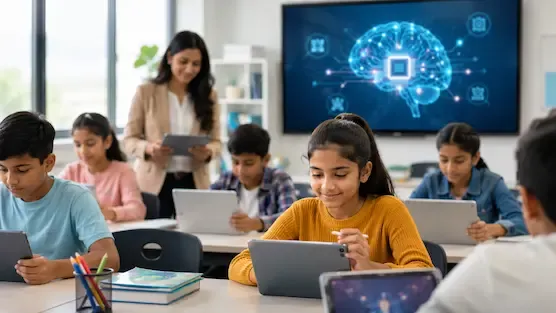
Students using digital learning tools and modern technology in a classroom environment representing the future of AI-powered education.
A student sitting at a desk in 2026 has access to something previous generations could only imagine.
Within seconds, a question can be explained in multiple ways, complex concepts can be simplified into easy summaries, practice tests can be generated instantly, and personalized learning plans can be created based on individual strengths and weaknesses.
The teacher is still present. The classroom still exists. But a new participant has quietly entered the learning process: artificial intelligence.
Across schools, colleges, and online learning platforms, AI-powered tools are transforming how students study, how educators teach, and how knowledge is delivered. What began as a technological experiment is rapidly becoming a significant force in modern education.
The question is no longer whether artificial intelligence will influence learning.
The question is how far that transformation will go.
For years, students relied on textbooks, libraries, and search engines to find information.
Artificial intelligence is changing that experience.
Instead of simply displaying information, modern AI tools can explain concepts, generate examples, provide personalized feedback, create quizzes, summarize lengthy chapters, and adapt explanations to different learning styles.
A student struggling with mathematics may receive step-by-step guidance. Another preparing for competitive examinations can generate customized practice material within minutes.
Also Read: Reviving a Civilizational Promise: President Droupadi Murmu Graces Nalanda University Convocation
The learning process is becoming increasingly interactive.
Rather than searching for answers, students are beginning to engage in conversations with technology.
Personalization Becomes the New Standard
One of the most significant changes AI brings to education is personalization.
Traditional classrooms often require teachers to address the needs of dozens of students simultaneously. While educators work hard to support different learning abilities, time and resource limitations remain challenges.
AI-powered systems can help bridge part of that gap.
Adaptive learning platforms can identify weak areas, recommend targeted exercises, and adjust content difficulty based on student performance.
Education experts believe this ability to customize learning experiences could improve engagement and help students progress at their own pace.
For many learners, the future classroom may feel less standardized and more individualized.
The Changing Role of Teachers
Despite growing technological capabilities, educators are not disappearing from classrooms.
In fact, many experts argue that AI may increase the importance of teachers rather than reduce it.
Technology can deliver information efficiently, but teaching involves far more than content delivery.
Teachers provide mentorship, emotional support, critical thinking guidance, classroom management, and social development—areas where human interaction remains essential.
Also Read: Science of Safety: India’s 2026 Healthcare Roadmap and Food Security Alerts
Many educational institutions are exploring how AI can handle repetitive administrative tasks while allowing teachers to focus more on meaningful student engagement.
The future of education may not be human versus machine.
It may be human and machine working together.
The rapid adoption of AI also raises important questions.
Educators and policymakers continue debating issues related to academic integrity, data privacy, misinformation, and excessive dependence on technology.
If students rely entirely on AI-generated answers, could critical thinking skills weaken?
How should schools evaluate assignments when advanced AI systems can produce sophisticated written content within seconds?
What safeguards are necessary to protect student data?
These questions are becoming increasingly relevant as educational technology evolves.
The challenge for institutions is finding a balance between innovation and responsibility.
Beyond changing classroom experiences, artificial intelligence is also reshaping future employment markets.
Many of today's students will enter workplaces where AI-powered tools are integrated into daily operations.
As a result, educational systems are beginning to place greater emphasis on digital literacy, problem-solving, creativity, communication, and analytical thinking.
Rather than competing with technology, future graduates may be expected to collaborate with it.
This shift is influencing discussions about curriculum design, assessment methods, and workforce preparation around the world.
The integration of artificial intelligence into education remains in its early stages.
Yet the pace of adoption suggests that AI will become an increasingly familiar part of academic life.
Schools and universities are experimenting with new models, technology companies continue introducing educational innovations, and students are embracing digital learning tools at unprecedented rates.
The classroom of the future may look different from today's classrooms, but its core mission remains unchanged: helping learners acquire knowledge, develop skills, and prepare for the challenges ahead.
The tools may evolve.
The purpose of education does not.
Every major technological revolution has eventually influenced education, from the printing press and radio to computers and the internet.
Artificial intelligence represents the next chapter in that evolution.
Its greatest potential lies not in replacing teachers or traditional learning but in making education more accessible, personalized, and efficient.
However, technology should remain a tool rather than the objective itself.
The true measure of educational success will not be how advanced classroom software becomes. It will be whether students emerge with stronger critical thinking abilities, deeper understanding, and the confidence to navigate an increasingly complex world.
The future classroom may be powered by artificial intelligence, but meaningful learning will always remain a profoundly human experience.