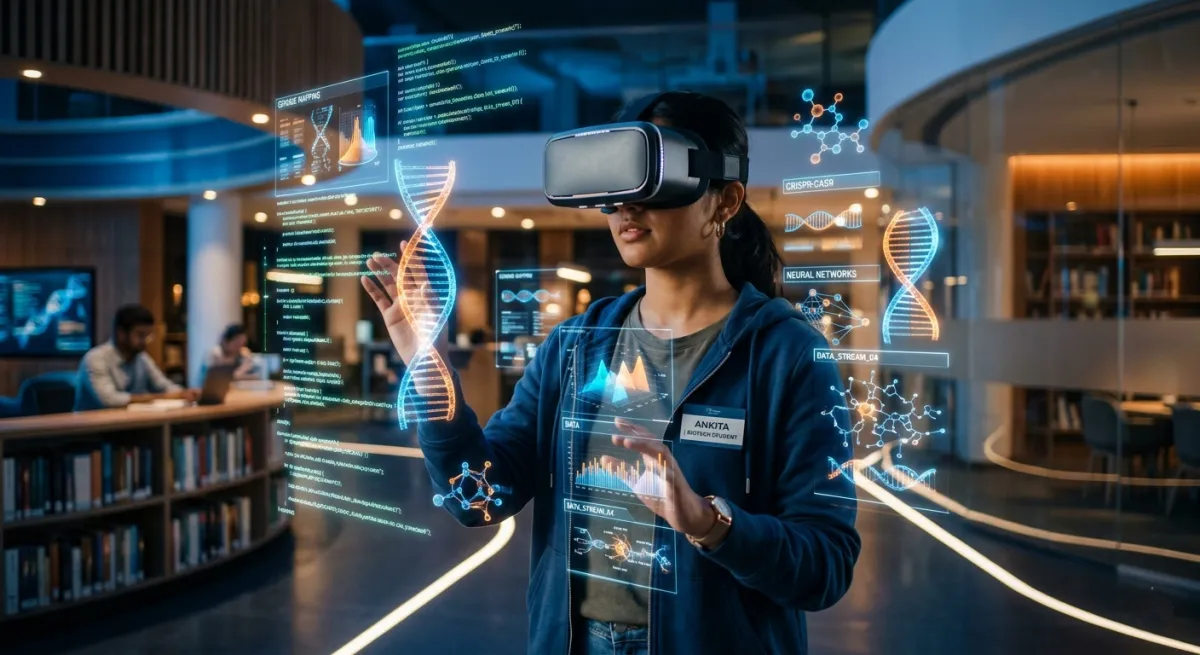

Engineers and AI researchers working inside a futuristic Indian technology and innovation workspace.
For years, artificial intelligence felt like a technology India was preparing for.
In 2026, that phase appears to be ending.
Across government policy, startups, corporate boardrooms, infrastructure projects, universities, and hiring markets, India is now moving aggressively toward becoming one of the world’s largest AI-driven economies. What once looked like experimental innovation is rapidly becoming a national strategy involving jobs, infrastructure, language technology, business automation, and economic competition.
The shift is happening at extraordinary speed.
From Mumbai to Bengaluru, from government-backed AI missions to startup ecosystems, India’s AI race has officially entered a serious new phase — and its effects are already beginning to reshape everyday life.
TCS Signals a Historic Shift in the Job Market
One of the biggest signals came from Tata Consultancy Services.
At a recent annual meeting, TCS Chairman N Chandrasekaran stated that the company expects a future where AI agents may eventually equal the number of human employees. He also acknowledged that the IT sector would likely never hire at the scale seen during the past two decades.
The statement was widely viewed as a major turning point for India’s technology industry.
For years, the country’s IT growth model depended heavily on massive hiring of engineers and fresh graduates. Artificial intelligence is now beginning to change that structure.
Instead of scaling only through workforce expansion, companies are increasingly focusing on automation, AI-assisted productivity, and specialized high-skill roles.
This does not necessarily mean traditional jobs are disappearing overnight. But it does indicate that India’s workforce model is evolving much faster than many expected.
Also Read: The AI Classroom: How Artificial Intelligence Is Changing the Way Students Learn
India Is Building Its Own AI Ecosystem
At the same time, India is no longer depending entirely on foreign AI systems.
The country is now actively investing in what policymakers describe as “sovereign AI” — the ability to build domestic AI infrastructure, Indian-language models, local datasets, and independent computing capability.
The India AI Impact Summit 2026 highlighted this ambition clearly. During the summit, officials outlined plans to expand national AI infrastructure with tens of thousands of GPUs and large-scale computing support under the IndiaAI Mission.
The broader goal is not simply to use artificial intelligence — but to build AI systems tailored for India’s population, languages, governance, agriculture, and economic conditions.
This shift could become extremely important in areas where global AI systems often struggle with regional languages and local data complexity.
Maharashtra Wants to Become an AI Powerhouse
Several Indian states are now competing to attract AI investment.
Maharashtra recently launched its first dedicated AI policy, aiming to attract over Rs.10,000 crore in investment over five years while generating nearly 1.5 lakh jobs. The policy also includes AI startup funding, AI incubators, and large-scale infrastructure support.
The state government plans to create AI-focused infrastructure zones and make artificial intelligence part of governance systems across departments.
This reflects a broader pattern emerging across India where AI is increasingly being viewed not only as a technology sector but also as a core economic development strategy.
Startups Are Entering the AI Gold Rush
India’s startup ecosystem is also rapidly adapting.
Reports show startup hiring has shifted strongly toward AI, data science, and specialized technology roles. According to recent hiring data, AI and data-related positions now represent a major share of startup recruitment across the country.
Indian AI startups are also receiving increasing investment attention.
Space-tech company SatSure recently secured funding support to develop AI-powered Earth observation systems using satellite and drone data for agriculture, infrastructure, climate forecasting, and disaster monitoring.
Meanwhile, Indian AI firms such as Sarvam AI are building large language models focused specifically on Indian languages and local deployment needs.
This suggests India’s AI movement is no longer limited to software outsourcing alone. It is increasingly spreading into: climate technology, agriculture, governance, mobility, language computing, satellite intelligence, automation systems.
AI Is Quietly Entering Everyday Infrastructure
Artificial intelligence is also beginning to appear inside public infrastructure itself.
Konkan Railway recently announced an AI-based monitoring system capable of detecting landslides, boulders, and even cattle movement during the monsoon season to improve railway safety.
Mumbai Metro has similarly deployed AI-assisted systems for predictive maintenance and monsoon preparedness.
These developments show how AI is gradually moving beyond chatbots and digital assistants into transportation, safety systems, public operations, and infrastructure management.
For ordinary citizens, this may become one of the most visible forms of AI adoption over the next decade.
But India’s AI Future Also Brings Big Questions
Despite the excitement, concerns are also growing.
Many experts warn that India’s workforce may struggle if skill development fails to keep pace with technological change. Entry-level hiring in some traditional technology roles has already slowed as automation expands.
At the same time, fears about misinformation, surveillance, digital dependence, and algorithmic bias continue increasing globally.
This means India’s AI expansion will require not only investment — but also strong governance, education reform, ethical safeguards, and workforce adaptation.
The challenge is no longer whether AI will influence society.
The challenge is how responsibly and inclusively that influence will unfold.
India’s AI race is no longer theoretical.
The country has now entered a phase where artificial intelligence is beginning to influence hiring, infrastructure, governance, startups, education, transportation, and economic planning simultaneously.
For businesses, AI may become the biggest productivity revolution in decades.
For workers, it may become the biggest adaptation challenge.
For India, it could become one of the defining technological transformations of the century.
The real question now is not whether AI will change India.
It is how quickly India can prepare its people for the future it is rapidly building.