
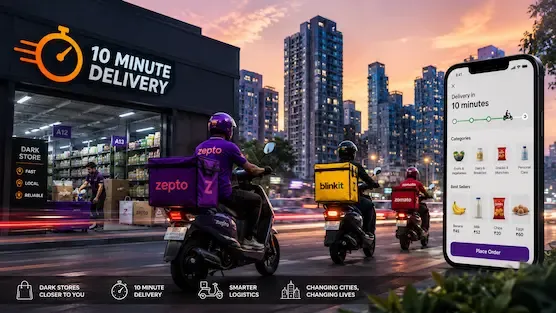
Electric delivery riders outside a modern dark store in an Indian city representing the rise of quick commerce and 10-minute delivery services in urban India.
Step out into the quiet residential lanes of any upscale locality in Mumbai, Pune, or Bengaluru at 7:00 AM, and you will hear a distinct, relentless sound—the frantic kick-start of electric scooters and the zipped closures of bright, branded delivery backpacks.
Long before the traditional neighborhood kirana store pulls up its shutter, a silent army of quick commerce delivery agents is already on the move. India's urban landscape has been rapidly reshaped by the 10-minute delivery promise, transforming an experimental hyper-local gimmick into a multi-billion dollar everyday infrastructure.
What began as an app-based option to order emergency groceries has blown up into a full-scale corporate war that is putting increasing pressure on traditional retail distribution channels across India's tier-1 and tier-2 cities.
The Architecture of the Dark Store Grid
The backbone of the 10-minute delivery model lies inside; it is engineered inside highly dense, micro-fulfillment centers hidden in plain sight, popularly known as "dark stores."
Unlike traditional e-commerce setups that rely on massive regional warehouses outside city boundaries, quick commerce operators rent out small, windowless basements or backspaces inside dense residential zones.
These locations are meticulously stocked using predictive algorithmic models that map the exact purchasing patterns of a three-kilometer radius.
The moment a user hits checkout on their phone, an automated packer inside the dark store has within minutes to scan, bag, and hand over the items to a waiting delivery agent. This high-speed operational loop has turned traditional retail storage metrics completely upside down.
This hyper-optimized speed has radically shifted consumer psychology. Urban working professionals are increasingly moving away from the age-old Indian habit of the "monthly ration haul," choosing instead to place multiple micro-orders throughout the day for everything from fresh coriander to premium electronics.
Retail market analysts tracking consumer behavior note that this trend has created an strong convenience-driven habit, where convenience completely trumps brand loyalty, leaving traditional retail brands with little choice but to list their products on these lightning-fast networks to maintain visibility.
Also Read: India’s Industrial Renaissance 2026: The Semiconductor Boom
The Friction: The Human Cost and the Kirana Crisis
Yet, a system that moves this fast inevitably creates severe friction points on the ground, and real journalism requires looking beneath the flashy user interface. The primary friction is felt by the multi-generational neighborhood kirana stores, which have served as the backbone of India's retail economy for decades.
Small shopkeepers find it impossible to compete with the deep-pocketed discounting structures and instant fulfillment infrastructure of tech aggregators, causing a steady drop in footfalls for dry groceries.
Simultaneously, the immense pressure of the ticking 10-minute clock is carried directly on the shoulders of the gig workforce. Delivery riders navigating high-traffic urban corridors are forced to take sudden risks to meet rigid platform algorithms, sparking major debates regarding road safety, unfair delivery tracking mechanics, and the lack of basic healthcare institutional security for gig laborers.
Regulatory Overhauls and the Road Ahead
As quick commerce networks expand their catalog to include high-value consumer electronics and fast-moving apparel, national competition watchdogs are keeping a close watch on potential predatory pricing structures to maintain a level playing field.
Officials familiar with the Industry experts expect regulators to push for between consumer protection councils and logistical tech consortiums said both sides are expected to accelerate implementation of more transparent algorithmic dispatch protocols in the coming months to prioritize rider safety over sheer delivery velocity.
Quick commerce is a technological marvel that has undoubtedly brought unmatched convenience to the busy lives of urban Indians. However, an ecosystem built entirely on the high-pressure delivery ecosystem of gig riders and the systematic displacement of local kirana stores cannot be called a flawless revolution.
As cities adapt to this digital grid, the definition of a "smart city" must expand to protect its most vulnerable stakeholders. True progress lies in balancing consumer convenience with human dignity and local economic sustainability.