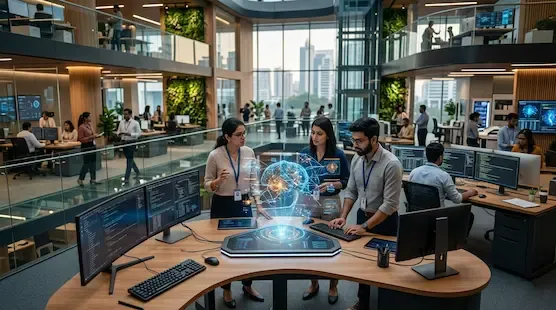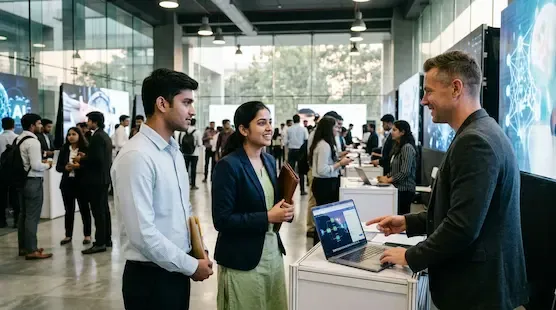

Young engineering graduate holding resumes outside a modern tech park in India, symbolizing the growing employability and fresher job crisis in the technology sector.
It is a scorching afternoon outside a prominent tech park in Pune. Rahul, a 22-year-old computer science a large number of engineering graduates from a tier-2 college, stands near a tea stall, nervously readjusting a folder containing ten copies of his resume.
Over the last four months, he has applied to over two hundred entry-level job postings online, only to receive automated rejection emails or absolute silence. For decades, an engineering degree in India was seen as a guaranteed ticket to financial stability and middle-class prosperity.
Today, that golden ticket is losing its luster, leaving a massive generation of fresh graduates stranded in an unforgiving job market.
The traditional mass-hiring pipeline that once absorbed hundreds of thousands of fresh engineers every single year has undergone a major structural shift, creating an immense employability crisis.
Historically, India’s multi-billion dollar IT services giants operated on a predictable volume-driven recruitment model.
Also Read: The Education Shift of 2026: Top 10 High-Paying Careers and Skills That Degrees Can’t Teach You
They visited hundreds of engineering campuses, picked up fresh graduates in bulk, and spent months training them on the bench before deploying them to global projects. However, changing international client demands and the aggressive integration of cloud-based automation tools have significantly disrupted this cycle.
Companies are no longer willing to fund massive benches of untrained freshers. Instead, the recruitment center of gravity has shifted entirely toward lateral hires who possess immediate, day-one production capabilities.
Placement officers across regional engineering colleges in Maharashtra and Karnataka note that traditional day-one campus recruitment drives have dropped sharply across several campuses over the last consecutive cycles.
Even the few companies that do visit have heavily escalated their entry-level screening rounds, shifting the baseline selection criteria from basic theoretical programming to advanced real-world project portfolios.
The root of this fresher crisis lies deep within India's outdated academic infrastructure. While the global tech industry has rapidly transitioned toward machine learning architecture, full-stack frameworks, and cloud computing, the vast majority of engineering colleges continue to teach decades-old syllabi focused on rote learning and theoretical memory.
Also Read: The Scholarship Race: How Rising College Costs Are Reshaping Student Life in India
This massive disconnect creates an ironic market paradox—while lakhs of engineering graduates are desperately hunting for jobs, hundreds of tech startups and core engineering firms complain that they cannot find qualified candidates with real, hands-on architectural problem-solving skills.
Education policy experts and industrial HR heads emphasize that the traditional four-year degree format is failing to keep pace with technological evolution. To survive the modern corporate landscape, freshers can no longer rely on their college degrees alone.
The modern engineer must transform into a continuous self-learner, actively building verifiable open-source projects and securing real-world apprenticeships long before their final semester exams.
As the volume of unemployed professional graduates climbs, regional technical universities are facing immense pressure to completely overhaul their internal examination frameworks.
An educational system that measures its success solely by the number of degrees it prints, while ignoring the ground realities of the economy, is doing a severe disservice to the country's youth. The fresher crisis is a loud wake-up call for India's higher education infrastructure. We cannot continue to run engineering colleges like high-volume degree ecosystems.
If we want to secure our demographic dividend, the focus must immediately pivot from hollow theoretical rote learning to deep, industry-aligned practical capability. Our youth deserve skills that build futures, not just degrees that collect dust.