
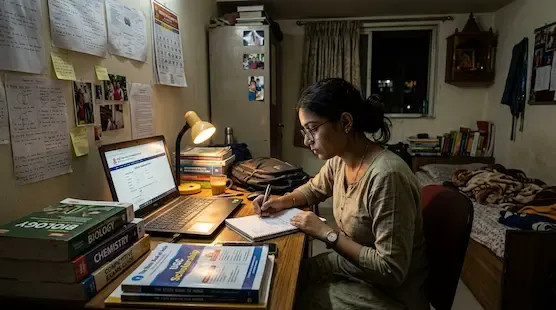
Indian college student studying late at night while managing scholarship applications and financial pressure inside a university hostel room.
The atmosphere inside India’s university hostels is quietly changing.
Late-night conversations that once revolved around semester exams, campus festivals, startup ideas, and career dreams are increasingly dominated by discussions about scholarship deadlines, education loan approvals, fee installment dates, and financial aid renewal requirements.
Across engineering colleges, management institutes, and private universities, higher education is becoming less about academic exploration and more about financial survival.
As tuition fees, hostel charges, transportation expenses, and living costs continue rising faster than the average income growth of middle-class households, thousands of students are finding themselves trapped inside an intense scholarship survival race.
For many families, securing admission into a prestigious institution is no longer the biggest challenge.
The real challenge begins after the admission letter arrives.
The Growing Weight of Education Debt
One of the strongest forces driving the scholarship rush is the rapid expansion of education-related financial pressure.
Banking trends and education loan data show a steady rise in student borrowing across India, particularly in professional degree programs such as engineering, medicine, management, and private technical education.
At the same time, the employment landscape has become far less predictable.
Also Read: The Scholarship Race: How Rising College Costs Are Reshaping Student Life in India
The once-popular belief that a professional degree automatically guarantees a high-paying job is steadily weakening. Entry-level salary packages across multiple sectors are normalizing, while living expenses in major cities continue climbing sharply.
This growing mismatch has deeply altered student psychology.
Inside many campuses, maintaining scholarship eligibility has evolved into a high-pressure survival mechanism. Students are no longer chasing high CGPAs only for academic pride or research ambition. For many, grades directly determine whether their families can continue funding their education without falling deeper into debt.
A small drop in performance can sometimes mean losing critical fee concessions or merit-based financial support — instantly increasing the economic burden on households already operating under financial stress.
The Rise of the Dual-Life Student
The financial pressure is also reshaping everyday student life.
To manage rising personal expenses, many students are increasingly balancing academics alongside part-time freelance work, online tutoring, content creation, gig economy jobs, internships, and remote digital assignments.
In urban campuses especially, the “dual-life student” is becoming increasingly common — attending lectures during the day while completing paid online work late into the night.
While this flexibility helps students survive financially, it also comes with emotional and psychological costs.
Student mentors and university counselors report growing levels of anxiety, exhaustion, burnout, and constant performance pressure among young adults attempting to balance academic expectations with financial responsibilities.
In many cases, campus life itself begins fading into the background.
Participation in student clubs, sports, cultural events, leadership activities, and creative exploration often becomes secondary when survival depends on maintaining grades while earning enough money to stay enrolled.
Higher education slowly transforms into a transactional race rather than a period of intellectual and personal growth.
Also Read: Scholarship Guide 2026: NSP 2.0 Portal Opens, Reliance Postgraduate Scholarships
Scholarships as a Lifeline
Despite these pressures, scholarships continue to play a transformative role for millions of students across the country.
For first-generation learners, rural students, and lower-middle-income households, financial aid often represents the only pathway toward accessing quality higher education.
Digital scholarship portals, nonprofit education foundations, and corporate social responsibility initiatives have improved awareness and accessibility compared to previous decades. Students from smaller towns now have greater visibility into national-level scholarship opportunities that were once difficult to access.
But experts warn that scholarships alone cannot permanently solve the deeper affordability crisis developing inside higher education.
When educational inflation consistently outpaces household income growth, even merit-based financial aid systems begin operating under immense strain.
The Debate Over Rising Educational Costs
The rapid commercialization of higher education has become one of the most debated issues within India’s academic landscape.
Private universities continue expanding campuses, infrastructure projects, international collaborations, and premium facilities. While these developments improve institutional branding and student amenities, they also contribute to steadily rising operational costs that are ultimately transferred to students through higher fees.
Education policymakers and regulatory bodies are increasingly discussing stronger fee transparency frameworks, expanded need-based financial support systems, and more balanced scholarship distribution models to protect vulnerable student groups.
The challenge, however, extends beyond regulation.
The larger question confronting India is whether quality higher education is gradually becoming accessible only to families capable of sustaining long-term financial pressure.
Also Read: Science of Safety: India’s 2026 Healthcare Roadmap and Food Security Alerts
Akhand News Viewpoint
A nation that forces its brightest young minds to treat education as a relentless financial battlefield risks weakening its own future.
The scholarship survival race unfolding across Indian campuses is not simply an education story — it is a reflection of a deeper economic reality facing middle-class and aspiring households across the country.
Scholarships were originally designed to reward talent, encourage excellence, and reduce historical inequalities. They were never meant to become emergency survival tools for students struggling against unchecked educational inflation.
India’s demographic strength lies in the ambition, intelligence, and potential of its youth. But that potential can only flourish when higher education remains accessible without pushing families into years of financial insecurity.
Degrees should open doors to opportunity — not begin with the burden of survival.