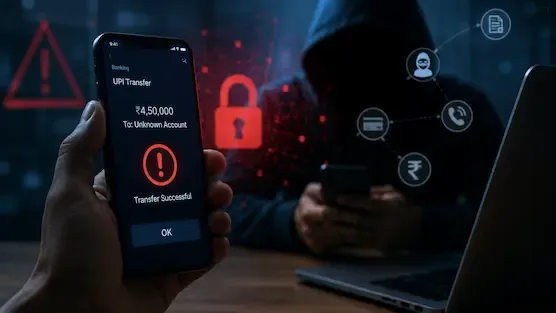

Young Indian smartphone user receiving a suspicious cyber fraud call in a dark indoor setting, symbolizing rising digital scams, online banking fraud, and cybercrime threats in India.
At exactly 8:47 PM, Priya Sharma, a 34-year-old private employee in Pune, receives a WhatsApp video call from an unknown number carrying the display picture of a police officer. The caller speaks in a calm but threatening tone, claiming that her Aadhaar card has been linked to illegal financial activity and that an arrest warrant is already being processed.
Before Priya fully understands what is happening, she is instructed to stay “under digital surveillance,” avoid contacting family members, and immediately transfer funds for “verification.”
Within the next forty minutes, her savings account is emptied.
Across India’s rapidly expanding digital economy, cybercrime is no longer limited to amateur OTP scams or suspicious lottery messages. A highly organized underground ecosystem of fraud networks is evolving at frightening speed, weaponizing fear, artificial intelligence, leaked personal data, and psychological pressure against ordinary citizens.
As smartphone penetration and UPI transactions explode across urban and rural India alike, the country is entering a dangerous new phase of digital vulnerability.
Cybercrime investigators report that fraud operations have become significantly more sophisticated over the last two years. The latest scam model—popularly known as the “digital arrest” scam—relies entirely on intimidation and emotional manipulation rather than technical hacking.
Victims receive fake calls impersonating police officers, telecom regulators, courier agencies, or banking authorities. Fraudsters often use forged ID cards, edited government logos, fake FIR documents, and AI-generated voice cloning to create a convincing atmosphere of panic.
Once the victim is psychologically cornered, scammers isolate them emotionally, forcing them to remain on continuous calls while demanding urgent financial “verification” transfers through UPI channels or temporary “safe accounts.”
Cybersecurity analysts warn that elderly citizens, first-time digital banking users, and financially stressed individuals are particularly vulnerable because fear overrides rational decision-making during high-pressure interactions.
The explosion of cyber fraud is also linked to the growing black-market circulation of personal user data.
Every online form, shopping app, loan application, or unsecured third-party website leaves behind fragments of sensitive information—phone numbers, addresses, Aadhaar-linked details, and banking patterns. Data brokers and illegal phishing networks frequently recycle this information to design highly targeted scams that feel frighteningly personal.
Also Read: The New Digital Scam Economy: How Fake Loan Apps and OTP Frauds Are Trapping Indians
Digital safety experts point out that modern cybercrime succeeds not because citizens are “uneducated,” but because fake websites, payment links, and customer support systems now look nearly identical to genuine interfaces.
The trust gap between authentic and fraudulent digital systems is shrinking rapidly.
India’s cybercrime reporting infrastructure is struggling to keep pace with the scale and speed of these financial attacks.
Once stolen funds are transferred across layered mule accounts, crypto wallets, or temporary UPI handles, tracing and freezing transactions becomes extremely difficult within the limited “golden hour” available to investigators.
While banks and regulators have strengthened fraud reporting systems and introduced transaction alerts, cybersecurity professionals argue that reactive policing alone cannot solve the crisis.
The next phase of protection will depend heavily on predictive AI security systems capable of detecting unusual behavior patterns—such as sudden high-value transfers from elderly users or multiple rapid transactions to newly created payment accounts.
Beyond financial losses, digital fraud is quietly creating a deep emotional crisis.
Victims frequently report severe anxiety, shame, sleep disorders, and social withdrawal after losing their life savings. Many avoid filing complaints altogether due to fear of embarrassment or public judgment.
Also Read: 5 Digital Safety Rules You Must Follow in 2026 to Protect Your Bank Account from AI Scams
Mental health professionals note that cyber fraud attacks feel deeply personal because the invasion occurs inside trusted spaces—phones, family chats, banking apps, and private conversations.
In a society rapidly transitioning toward a fully digital financial ecosystem, public trust itself is becoming the most valuable asset under attack.
India’s digital revolution has brought unmatched convenience and financial inclusion to millions, but convenience without strong security creates a fragile system. Cyber fraud is no longer a minor technical issue—it is a national social and economic challenge.
Citizens cannot be expected to fight highly organized digital crime syndicates alone. Stronger platform accountability, faster financial freezing systems, aggressive cyber policing, and mass digital awareness campaigns are now essential. In the smartphone era, protecting public trust is just as important as protecting money itself.