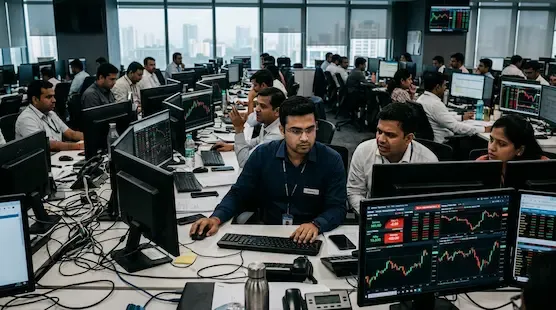

Investors using digital platforms representing the rapid growth of India's stock market participation.
A little over a decade ago, investing in the stock market was often seen as an activity reserved for finance professionals and experienced investors.
Today, that perception is rapidly changing.
India's National Stock Exchange (NSE) has crossed the landmark of 26 crore trading accounts, highlighting the extraordinary expansion of retail participation in the country's capital markets. According to the exchange, the latest one crore accounts were added in less than four months, underlining the pace at which investing is becoming part of everyday financial planning.
The rise of smartphone-based trading platforms, simplified account opening processes, and increasing financial awareness has fundamentally changed how Indians approach wealth creation.
Opening a demat account, which once involved lengthy paperwork, can now be completed digitally within a short period. Easy access to market information and investment education has also encouraged first-time participants to explore equities alongside traditional savings options.
Industry experts believe this digital transformation has played a major role in broadening the investor base beyond metropolitan cities.
One of the most significant developments has been the growing participation from smaller towns and emerging urban centers.
As internet penetration and digital payment infrastructure have expanded, investing has become increasingly accessible to a wider population. This trend reflects the broader financial inclusion story unfolding across the country.
Market analysts note that retail participation is no longer concentrated in a handful of large cities, creating a more geographically diverse investor ecosystem.
While rapid growth often attracts attention, experts argue that the quality of participation matters just as much as the numbers.
Over the past few years, many investors have gradually shifted from purely speculative trading toward systematic investing through SIPs, diversified portfolios, and long-term wealth creation strategies.
Financial literacy campaigns and greater availability of research tools have encouraged investors to focus more on business fundamentals rather than short-term market excitement.
The expanding investor base presents significant opportunities for India's capital markets.
A larger pool of domestic investors can strengthen market liquidity and reduce dependence on global capital flows. At the same time, experts continue to emphasize the importance of disciplined investing, risk management, and diversification.
Stock markets naturally experience periods of volatility, and long-term success often depends on patience rather than short-term reactions.
Also Read: Market Marvel: Sensex & Nifty Scale New All-Time Highs as FY 2026-27 Begins
The milestone of 26 crore trading accounts is not simply a statistic. It reflects a larger transformation in the way Indians think about savings, investments, and financial independence.
As more households participate in the equity market, the conversation is gradually moving beyond quick profits toward long-term wealth creation. That shift may ultimately become one of the most important developments in India's financial journey.
The real story is not just that more people are investing.
It is that investing itself is becoming a mainstream part of modern India's economic culture.