
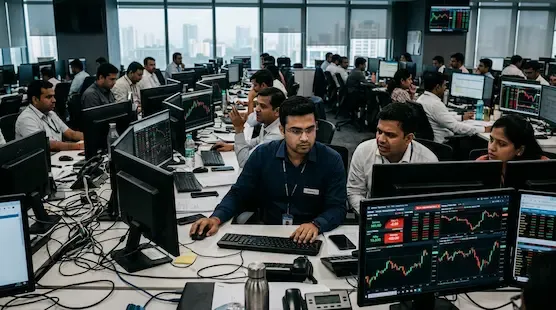
Indian stock market traders monitoring volatile Sensex and Nifty movements on multiple trading screens inside a financial dealing room representative image.
Inside dealing rooms across Mumbai’s Dalal Street on Wednesday morning, traders watched flashing red and green screens with growing frustration. Every sharp market dip was instantly bought back within minutes, yet every rally struggled to sustain momentum.
The Sensex and Nifty are no longer moving like traditional bull markets driven by pure optimism. Instead, India’s stock market has entered a tense financial tug-of-war between nervous foreign investors pulling money out and relentless domestic investors continuing to buy every correction.
The result is a strange, exhausting market phase where volatility dominates headlines, but a complete collapse refuses to arrive.
The biggest structural pressure currently weighing on Indian equities is the historic scale of Foreign Institutional Investor (FII) selling.
In 2026 alone, foreign investors have already pulled more than ₹2 lakh crore out of Indian equities as global capital aggressively rotates toward markets linked to artificial intelligence, semiconductor manufacturing, and cheaper valuations.
Global hedge funds and sovereign wealth managers increasingly believe Indian markets are trading at expensive valuation premiums compared to other emerging economies. Rising geopolitical uncertainty, volatile crude oil prices, and weak global technology earnings have further intensified the cautious sentiment.
For years, FIIs were the dominant force capable of driving massive rallies on Dalal Street. Today, however, their confidence appears deeply shaken.
Yet despite this relentless foreign selling, Indian markets are refusing to completely break down.
The reason lies inside the powerful rise of domestic institutional investors (DIIs), SIP inflows, and retail participation. Every month, lakhs of middle-class Indians continue investing through mutual fund SIPs, systematically absorbing the selling pressure created by FIIs.
This structural transition is changing the DNA of the Indian market itself.
Earlier, market sentiment depended heavily on Wall Street and foreign capital flows. Now, India’s expanding retail investor ecosystem is acting as a stabilizing shock absorber during periods of global panic.
However, market strategists warn that domestic optimism alone may not be enough to trigger runaway bull rallies unless corporate earnings growth improves significantly.
Interestingly, one of the strongest themes driving short-term market momentum right now is India’s brutal summer heatwave.
As temperatures across multiple states touch extreme levels, the country’s electricity demand has surged to record-breaking highs above 270 GW.
This has triggered aggressive investor interest in power generation companies, transmission infrastructure firms, cooling appliance manufacturers, and select energy-linked stocks. Power-sector counters have recently emerged among the strongest-performing pockets of the market.
Simultaneously, falling crude oil prices are offering relief to inflation-sensitive sectors such as aviation, paints, logistics, and oil marketing companies.
The modern stock market is no longer reacting only to balance sheets and quarterly profits. Climate patterns, global wars, commodity shocks, and AI-driven capital flows are now influencing Indian equities every single day.
Brokerages and market analysts increasingly believe India is entering a “stock picker’s market” rather than a broad-based bull run.
Also Read: Market Pulse: Sensex Fights Back, But Gold Steals the Show at Record ₹82,000+
This means blindly investing in the entire market may no longer generate easy wealth like earlier post-pandemic years. Instead, sector-specific themes — such as power infrastructure, manufacturing, defense, railways, and selective consumption plays — are attracting concentrated investor attention.
Meanwhile, several overvalued pockets of the market continue facing pressure due to stretched valuations and slowing earnings growth.
Retail traders chasing momentum through social media tips are finding themselves trapped inside violent intraday swings where emotions move faster than fundamentals.
India’s stock market is currently reflecting a much deeper transition happening inside the global economy itself. Foreign investors are chasing AI-led technological revolutions abroad, while domestic investors continue betting on India’s long-term demographic and infrastructure story. Neither side is entirely wrong.
But this phase also exposes an important truth: wealth creation in modern markets is becoming increasingly difficult for emotional, short-term traders. The era of easy money and blind bull runs is fading. In the years ahead, disciplined investing, sector understanding, and patience may matter far more than hype-driven speculation.