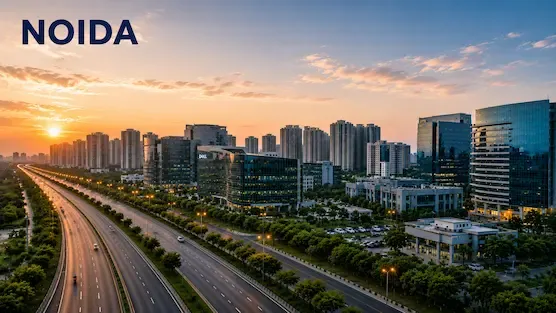
Modern skyline of Noida featuring the Noida Expressway, corporate office towers, residential high-rises, and green urban infrastructure during sunset, symbolizing the city’s rapid smart city transformation representative image.
Driving down the flawlessly paved, multi-lane Noida Expressway during twilight, the skyline tells a story of aggressive, calculated ambition. Massive glass-facade IT parks, looming residential towers, and neatly divided sectors roll past in an orderly fashion that feels noticeably different from the unplanned growth seen in many older Indian metros.
Noida, once considered a quiet satellite town of Delhi, has quietly engineered a massive transition into one of India’s fastest-growing urban and technology corridors.
However, behind the glittering corporate offices and planned layouts lies a deep, complex story of economic shift, immense migration, and severe urban pressures.
The Pillars of the Infrastructure and Tech Boom
Unlike other corporate hubs that grew organically and choked under their own weight, Noida’s primary weapon has been its rigorous urban layout.
Also Read: The Future of Living: Top 5 Smart Cities in India to Invest in 2026 for Maximum Returns
The wide grid-based sector roads, sprawling metro connectivity stretching deep into Greater Noida, and seamless highway networks have made the city highly accessible.
This planned foundation has turned Noida into a magnet for heavy technology and global electronics manufacturing.
Today, from massive data centers and multi-national IT parks to major smartphone manufacturing units, the city is rapidly absorbing the startup and corporate overflow from Delhi and Gurugram, driven primarily by lower commercial rental costs.
Young software professionals and structural engineers moving from Gurugram point out that while Gurgaon developed as a corporate jungle with severe water-logging and patchy internal roads, Noida offers a significantly cleaner grid layout and better initial living spaces for families at nearly relatively lower real estate entry costs.
The Jewar Airport Catalyst and Mega Projects
The real game-changer for Western Uttar Pradesh’s economy, however, is the rapid development of the upcoming Noida International Airport at Jewar. This mega aviation hub has significantly transformed the region's geopolitical and economic value.
Heavy industries and logistics giants are scrambling to lock in land parcels along the Yamuna Expressway.
With the upcoming Film City project, integrated multi-modal logistics hubs, a growing semiconductor ecosystem, and planned Rapid Rail (RRTS) connectivity on the horizon, the city is anchoring itself as Northern India’s primary economic engine.
Urban planning and economic analysts state that the Jewar Airport is not just an infrastructure project; it is an economic corridor that will shift the logistics center of gravity from Delhi directly into Western UP.
Also Read: Maharashtra AI Policy 2026: Revolutionizing Governance, Startups, and the Job Market
It will bridge the manufacturing gap, potentially generating large-scale employment opportunities over the next decade.
The Friction: Traffic, Pollution, and Urban Inequality
But a city cannot scale this fast without fracturing at the edges, and real journalism demands looking at those cracks. The massive influx of professionals has put severe pressure on core traffic junctions, leading to major evening bottlenecks at entries like the DND Flyway and Pari Chowk.
Furthermore, sky-rocketing real estate prices are rapidly pushing affordable housing out of the reach of the middle class, creating a stark visual divide between luxury high-rises and neighboring rural pockets.
Environmental concerns are also escalating, with local groundwater levels dipping at an alarming rate, seasonal winter smog choking the sectors, and concrete expansion eating into the city’s green lungs.
The Structural Future
Managing this aggressive growth while preserving the city’s clean public parks and basic water resources will require immense regulatory balancing from the state administration.
Noida's journey from a manufacturing backyard to a major example of planned urban expansion in modern India. Yet, its ultimate success will not be measured by the height of its skyscrapers or the speed of its airport runway, but by how it manages its ecological footprints and social divides.
A smart city must remain liveable for the common delivery agent and laborer just as much as it is for the corporate executive.