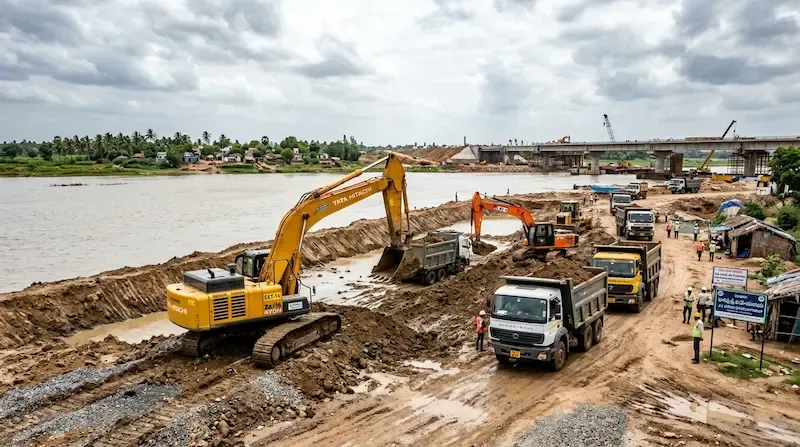
Heavy excavation machinery clearing a wide civic drainage canal in an urban area under the supervision of municipal infrastructure engineers.
The seasonal transition across the Chhatrapati Sambhajinagar district and neighboring Marathwada corridors has triggered intense activity across local administrative circles long before the arrival of the first monsoon showers. Inside the district collectorate and municipal corporation headquarters, evaluation meetings are running around the clock to review the structural safety of regional water storage networks, canal pathways, and low-lying urban drainage systems. Unlike previous years where desilting operations faced scheduling delays, the regional command has enforced a strict deadline compliance policy this season to prevent urban flooding and optimize rainfall retention across the water-scarce belt.
This localized administrative push is shifting operational priorities on the ground, making real-time structural monitoring the primary benchmark for pre-monsoon clearing operations.
Also Read: Inside Noida’s Transformation Into One of India’s Fastest-Growing Smart Cities
The primary mechanism driving this immediate regional mobilization is the critical maintenance requirement across major and medium irrigation projects in the Godavari basin grid. Engineering divisions from the state irrigation department are actively conducting physical safety audits of dam sluice gates, earthen embankments, and major distribution canals to handle sudden heavy inflows without structural stress. Automated water-level tracking systems are being thoroughly calibrated across major reservoirs to ensure transparent, real-time data sharing between upstream monitoring stations and downstream agricultural command areas.
This strict engineering focus has completely re-aligned regional logistics. Sub-divisional officers and rural dynamic teams are closely supervising the physical clearing of natural streams and connecting channels that feed into local community lakes. The emerging administrative directive across irrigation circles emphasizes that eliminating unauthorized blocks and restoring historical water flow lines is non-negotiable to secure groundwater recharging zones and protect agricultural land from soil erosion during heavy cloudburst events.
Also Read: Maharashtra 2026: The Battle for Mantralaya, Shakti Peeth Expressway Progress…
Consequently, this urgent push for monsoon readiness is driving a massive infrastructural overhaul across the civic layouts of Chhatrapati Sambhajinagar city. Municipal sanitation teams and heavy machinery operators have expanded their working hours to clear the primary storm-water drainage networks cutting through dense commercial hubs and historic residential sectors. The removal of heavy plastic waste and accumulated silt from choked arterial lines is being tracked via geospatial mapping to ensure complete transparency in civic spending.
This widespread cleanup operation is causing minor, temporary adjustments across urban transport corridors. Rather than allowing unchecked traffic congestion around major transit squares during desilting shifts, regional traffic departments are actively coordinating with civic contractors to deploy smart diversion routes and clear roadside blockages.
Infrastructure planners highlight that these synchronized efforts are vital to stabilize urban public transit networks and ensure absolute commuter safety when high-velocity seasonal winds and sudden rainfall hit the city center.
As district technical teams continue to aggressively monitor urban safety systems, rural agricultural support networks are simultaneously deploying localized safety measures.
Officials familiar with the internal coordination between the district agricultural commission and rural block development centers said both sides are expected to accelerate the distribution of weather-resilient storage guidelines in the coming weeks to protect local produce warehouses and community seed banks from unexpected moisture damage.
Akhand News Viewpoint: A regional administration that measures its monsoon readiness solely by the volume of files processed in air-conditioned offices, rather than the physical clearance of drains and safety of dams on the ground, leaves its citizens vulnerable. The ongoing pre-monsoon push across Marathwada is an essential step toward building long-term climate resilience in a region historically caught between extreme droughts and sudden, unseasonal downpours.
While administrative planning is vital, the ultimate success of these measures depends entirely on continuous ground execution and strict contractor accountability. Protecting our cities from flash floods and securing every drop of water for our farmers is not just a seasonal civic duty; it is the absolute foundation of our regional economic survival.