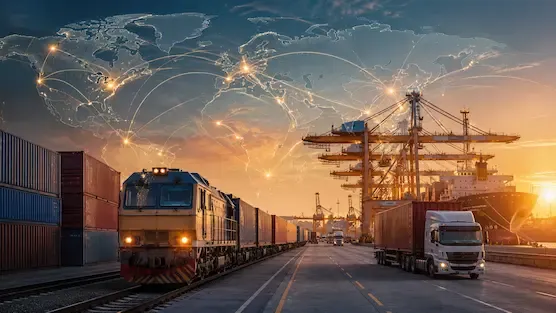
Modern global logistics infrastructure representing international trade and supply chain connectivity representative image.
For decades, the global economy was built on a simple assumption: manufacture where costs are lowest and ship products wherever demand exists.
This model powered an era of globalization that connected factories, ports, and consumers across continents. A smartphone assembled in one country could contain components produced in five others before finally reaching customers thousands of kilometers away.
Today, that system is undergoing one of its biggest transformations in modern economic history.
Governments and multinational companies are increasingly reassessing where they source critical materials, build factories, and establish long-term trade relationships. Rather than focusing solely on cost efficiency, resilience and strategic reliability are becoming central priorities.
The result is a gradual redrawing of the global supply chain map.
A World Learning From Disruption
Recent years have demonstrated how vulnerable interconnected supply networks can become during periods of international disruption.
Shipping delays, rising freight costs, production bottlenecks, and geopolitical uncertainties have encouraged businesses to rethink their dependence on highly concentrated manufacturing ecosystems.
Trade analysts note that companies are increasingly adopting a diversification strategy, spreading production across multiple locations instead of relying on a single manufacturing hub.
This approach may reduce efficiency in the short term, but many businesses view it as a necessary investment in long-term stability.
The Rise of Strategic Partnerships
The changing supply chain landscape is strengthening the importance of trusted economic partnerships.
Countries are expanding trade cooperation through bilateral agreements, infrastructure projects, and investment partnerships designed to improve manufacturing capacity and logistics connectivity.
Rather than competing solely through low production costs, nations are increasingly positioning themselves as reliable long-term partners within global industrial networks.
Economists observe that this shift is encouraging greater regional integration, with neighboring economies working together to create more flexible production ecosystems.
Why Infrastructure Matters More Than Ever
Modern trade depends on more than factories.
Efficient ports, highways, freight corridors, rail networks, and digital logistics platforms have become critical components of international competitiveness.
Governments around the world are investing heavily in infrastructure designed to reduce transportation costs and improve supply chain efficiency.
Large logistics parks and multimodal transport hubs are increasingly viewed as strategic economic assets capable of attracting both domestic and international investment.
Technology Is Reshaping Global Commerce
Digital transformation is also playing an increasingly important role in modern trade.
Artificial intelligence, predictive analytics, and real-time inventory systems allow businesses to monitor global supply chains with unprecedented precision.
Companies can now identify disruptions earlier, optimize shipping routes, and manage inventory more efficiently than ever before.
Supply chain specialists believe that technology-driven visibility will become one of the defining competitive advantages of future global commerce.
Also Read: Inside India’s Underwater Defence Strategy as Maritime Threats Rise in the Indian Ocean
A More Balanced Global Economy
The restructuring of trade partnerships does not necessarily signal the end of globalization.
Instead, many experts view it as the evolution of globalization into a more diversified and resilient model.
Rather than concentrating production in a limited number of locations, businesses are building broader international networks designed to reduce risk while maintaining economic integration.
For consumers, these changes may remain largely invisible.
For governments and industries, however, the decisions being made today could shape global trade patterns for decades to come.
The future of international trade will not be determined solely by who can produce goods at the lowest cost.
Reliability, infrastructure, technology, and long-term strategic trust are rapidly becoming just as valuable as manufacturing capacity itself.
As the global economy adapts to a changing world, the countries that successfully combine efficient logistics with stable partnerships may emerge as the strongest players in the next generation of international commerce.
The modern supply chain is no longer just about moving products—it is increasingly about building confidence.